Exam prep · AP Calculus AB · Unit guide
AP Calculus AB Unit 8: Applications of integration
Average value, motion, area between curves, and volumes—explained clearly
On the exam: Average value, motion, area between curves, volumes. 10 to 15%.
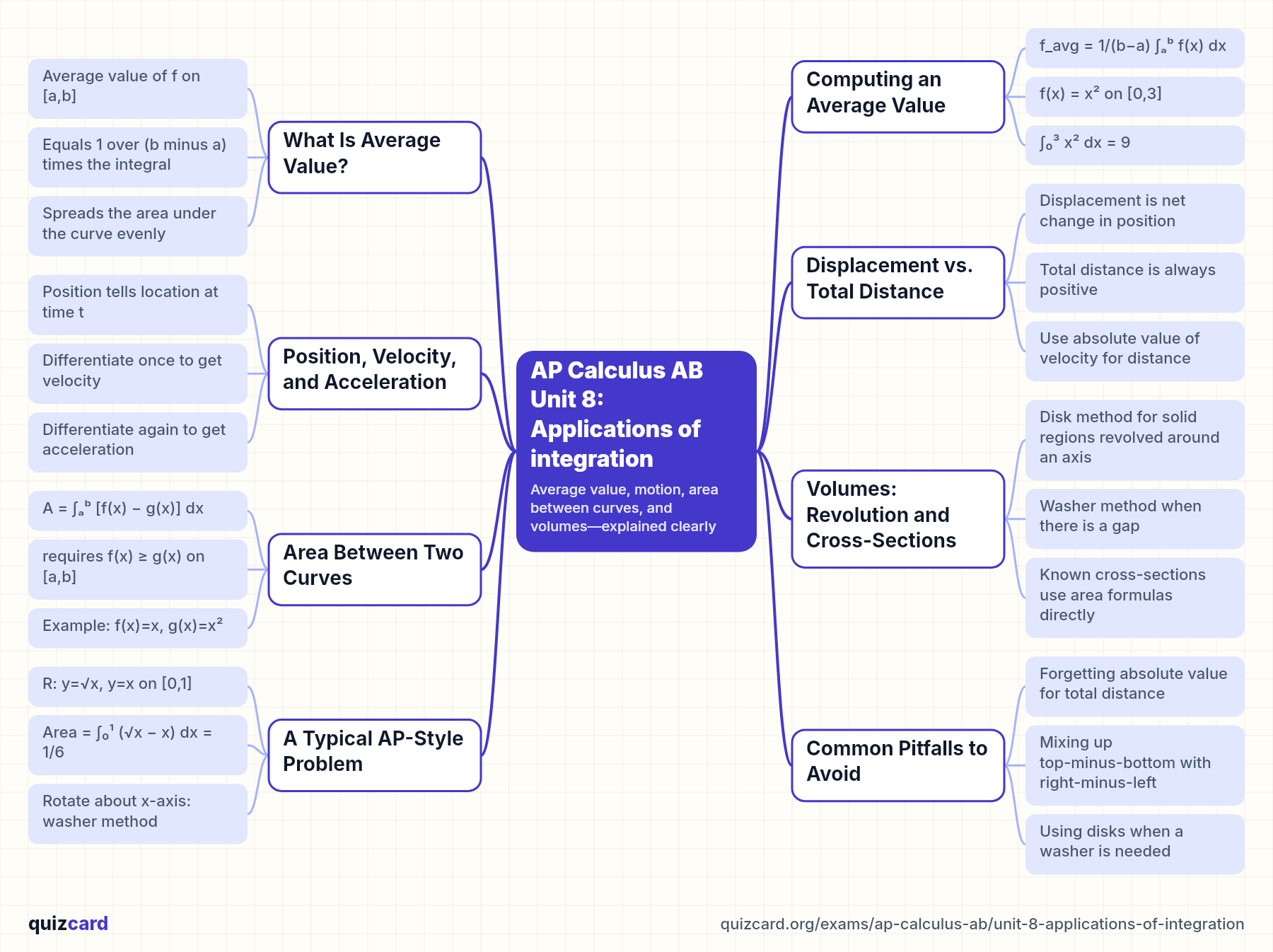
Quick question: if a car backs up and then drives forward again, is its total distance the same as its displacement? In AP Calculus AB, Unit 8 asks you to apply integration to average value, motion, area between curves, and volume. Let's work through each one clearly, with a real problem at the end.
What Is Average Value?
Here's a quick check: can you find the average value of a function without just averaging its two endpoints? The average value of f on an interval from a to b is one over b minus a, times the integral of f from a to b. It spreads the total area under the curve evenly across the interval, turning a whole curve into one representative height.
The average value of f on [a, b] equals 1/(b−a) times the integral of f from a to b. Mean Value Theorem for Integrals
Key points.
- Average value of f on [a,b]
- Equals 1 over (b minus a) times the integral
- Spreads the area under the curve evenly
- Guaranteed to occur by the Mean Value Theorem
Computing an Average Value
Let's try it. Take f of x equals x squared on the interval from zero to three. First we find the integral of x squared from zero to three, which comes out to nine. Then we divide by the length of the interval, three minus zero, giving us three. So the average value of x squared over that interval is three, even though the function climbs all the way up to nine at the right endpoint.
f_avg = 1/(b−a) ∫ₐᵇ f(x) dx
f(x) = x² on [0,3]
∫₀³ x² dx = 9
f_avg = (1/3)(9) = 3
Key points.
- Formula: 1 over (b minus a) times the integral
- Example uses f(x) = x squared on [0,3]
- Integral evaluates to 9
- Dividing by interval length gives 3
Position, Velocity, and Acceleration
Motion problems link three functions together. Position tells you where an object is at time t. Take its derivative and you get velocity, how fast and in which direction it's moving. Take the derivative again and you get acceleration. Go the other way with integration: integrating acceleration gives velocity back, and integrating velocity gives position back, each time up to a constant you find from initial conditions.
- Position s(t) gives location at time t
- Differentiate s(t) to get velocity v(t)
- Differentiate v(t) to get acceleration a(t)
- Integrate a(t) to recover v(t), plus a constant
- Integrate v(t) to recover s(t), plus a constant
Displacement vs. Total Distance
This is where many students lose points. Displacement is just the integral of velocity over time, the net change in position, and it can come out negative if the object ends up to the left of where it started. Total distance traveled is always positive. To find it, you integrate the absolute value of velocity, usually splitting the interval at the times when velocity equals zero and adding up the pieces.
Displacement
- Net change in position
- Integral of v(t) directly
- Can be negative, zero, or positive
Total Distance
- Sum of all distance traveled
- Integral of the absolute value of v(t)
- Always zero or positive
- Split interval where v(t) = 0
Area Between Two Curves
To find the area between two curves, you integrate the top function minus the bottom function across the interval where they overlap. Take f of x equals x and g of x equals x squared: they cross at x equals zero and x equals one, and x sits above x squared on that stretch. Integrating x minus x squared from zero to one gives one sixth, the enclosed area. If the curves swap which one is on top, you split the integral.
A = ∫ₐᵇ [f(x) − g(x)] dx
requires f(x) ≥ g(x) on [a,b]
Example: f(x)=x, g(x)=x²
intersect at x=0 and x=1
A = ∫₀¹ (x − x²) dx = 1/6
Key points.
- Integrate top function minus bottom function
- Find limits by setting curves equal
- Example: f(x)=x and g(x)=x squared
- Enclosed area works out to one sixth
Volumes: Revolution and Cross-Sections
For volumes, think of slicing the solid into thin pieces and adding up their areas times thickness, dx. Rotating a region around an axis gives disks, with volume pi times the integral of the radius squared, or washers when there's a gap, using pi times the integral of the outer radius squared minus the inner radius squared. If the cross-sections are squares or semicircles sitting on the base region instead, you integrate the area of that shape.
Key points.
- Disk method for solid regions revolved around an axis
- Washer method when there is a gap
- Known cross-sections use area formulas directly
- General rule: integrate area times thickness
A Typical AP-Style Problem
Let's work a typical problem. Region R is bounded by y equals the square root of x and y equals x, between x equals zero and x equals one. For the area, square root of x sits on top, so we integrate square root of x minus x from zero to one, giving one sixth. Now rotate R around the x axis. The outer radius is square root of x and the inner radius is x, so the washer formula gives pi times the integral of x minus x squared from zero to one, which works out to pi over six.
R: y=√x, y=x on [0,1]
Area = ∫₀¹ (√x − x) dx = 1/6
Rotate about x-axis: washer method
Outer radius √x, inner radius x
V = π∫₀¹ (x − x²) dx = π/6
Key points.
- Region R bounded by y = square root of x and y = x
- Area between them equals one sixth
- Rotate R about the x-axis using washers
- Resulting volume equals pi over six
Common Pitfalls to Avoid
A few mistakes show up again and again. Students forget the absolute value when total distance is asked for, forget to swap to right minus left when curves are given in terms of y, and reach for the plain disk formula when there's actually a hole in the middle, which calls for a washer instead. Always find your limits of integration first, by setting the two functions equal to each other and solving.
Key points.
- Forgetting absolute value for total distance
- Mixing up top-minus-bottom with right-minus-left
- Using disks when a washer is needed
- Skipping the step of finding intersection points
Remember this
The one thing to remember: integration always adds up tiny slices, whether that's area, distance, or volume. Figure out what you're slicing before setting up the integral. Try quizzing yourself on these AP Calculus AB problems next.
Practice this unit
- Algebra and Geometry: Essential Formulas quiz18 multiple-choice questions with explanations · no account needed
- AP Calculus AB: Limits, Continuity and Derivative Rules quiz15 multiple-choice questions with explanations · no account needed
- Calculus: Derivatives and Integrals30 flashcards · study free
- Algebra and Geometry: Essential Formulas30 flashcards · study free
- AP Calculus AB: Limits, Continuity and Derivative Rules34 flashcards · study free
Every AP Calculus AB deck and quiz: the AP Calculus AB hub.
Other AP Calculus AB unit guides
- Unit 1: Limits and continuityStudy guide
- Unit 2: Differentiation: definition and fundamental propertiesGuide + video lesson
- Unit 3: Differentiation: composite, implicit and inverse functionsStudy guide
- Unit 4: Contextual applications of differentiationStudy guide
- Unit 5: Analytical applications of differentiationGuide + video lesson
- Unit 6: Integration and accumulation of changeGuide + video lesson
- Unit 7: Differential equationsGuide + video lesson
Try it with your own material
Upload a PDF, slides or notes and study the deck in minutes. Making your own cards is free with no limits.