Exam prep · AP Calculus AB · Unit guide
AP Calculus AB Unit 6: Integration and accumulation of change
Riemann sums, the Fundamental Theorem, and u-substitution, exam-ready
On the exam: Riemann sums, the Fundamental Theorem, u-substitution. 17 to 20%.
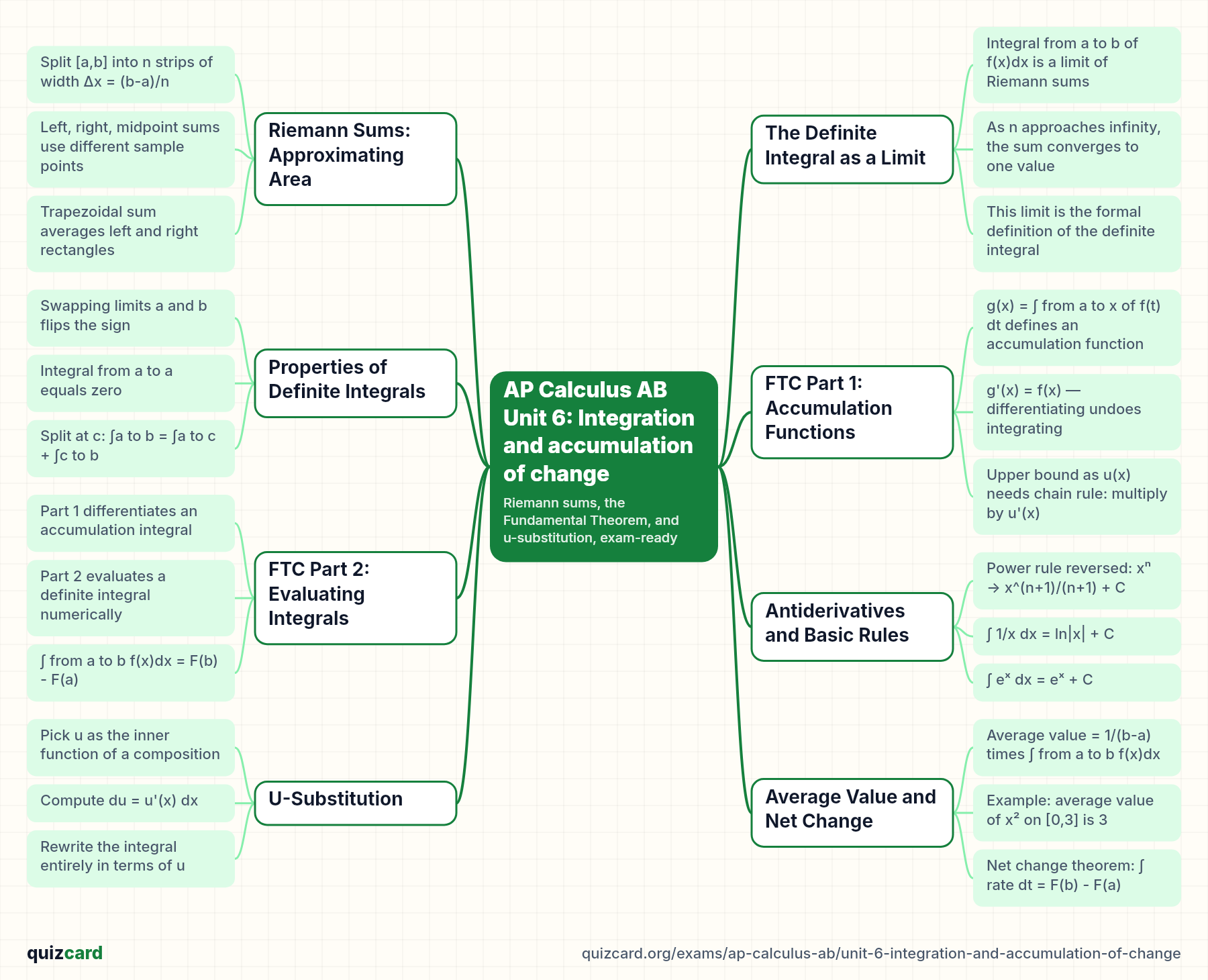
Area under a curve isn't just a shape — it's a running total of change, and that's exactly what Unit 6 is about. Worth 17 to 20 percent of the AP exam, this unit builds from Riemann sums to the Fundamental Theorem of Calculus to u-substitution. Let's walk through it the way the test actually asks it.
Watch the lesson
Watch on YouTube · 30-second version
Riemann Sums: Approximating Area
Imagine slicing the area under a curve into thin vertical strips. Each strip's height comes from the function, and its width is delta x, equal to b minus a over n. Left, right, midpoint, and trapezoidal sums all approximate the true area differently, and as the number of strips grows toward infinity, every method converges toward the same exact value: the definite integral.
Key points.
- Split [a,b] into n strips of width Δx = (b-a)/n
- Left, right, midpoint sums use different sample points
- Trapezoidal sum averages left and right rectangles
- More strips give a better approximation
The Definite Integral as a Limit
The definite integral turns approximation into an exact statement. We write the integral from a to b of f of x dx as the limit, as n goes to infinity, of the sum from i equals one to n of f of x sub i times delta x. On the AP exam you will see this limit notation used to justify why a Riemann sum equals an integral.
The integral from a to b of f(x) dx equals the limit as n approaches infinity of the sum of f(x_i) times Δx Definition of the definite integral
Key points.
- Integral from a to b of f(x)dx is a limit of Riemann sums
- As n approaches infinity, the sum converges to one value
- This limit is the formal definition of the definite integral
- Justifies why area approximations become exact
Properties of Definite Integrals
Definite integrals follow a few algebra-like rules the AP exam loves to test. Flip the limits of integration and the sign flips too. The integral from a point to itself is always zero. You can split an integral at any interior point c, so the integral from a to b equals the integral from a to c plus the integral from c to b, and constants factor straight out front.
Key points.
- Swapping limits a and b flips the sign
- Integral from a to a equals zero
- Split at c: ∫a to b = ∫a to c + ∫c to b
- Constants and sums factor in and out freely
FTC Part 1: Accumulation Functions
The first part of the Fundamental Theorem says that if g of x is defined as the integral from a to x of f of t dt, then g prime of x equals f of x: differentiating undoes integrating. When the upper limit is itself a function, like u of x, you multiply by u prime of x using the chain rule. AP free-response questions frequently ask you to analyze these accumulation functions.
- Define g(x) as the integral from a to x of f(t)dt
- Apply FTC1: g'(x) = f(x)
- If bound is u(x), multiply by u'(x) via chain rule
- Use g' to find intervals of increase, decrease, concavity
FTC Part 2: Evaluating Integrals
Part one of the Fundamental Theorem differentiates an accumulation integral back into the original function. Part two does the opposite job: it evaluates a definite integral directly. It says the integral from a to b of f of x dx equals F of b minus F of a, where F is any antiderivative of f. This is the formula you will actually use to compute numerical answers on the exam.
FTC Part 1
- Differentiates an accumulation integral
- g'(x) = f(x)
- Tests derivative rules plus chain rule
FTC Part 2
- Evaluates a definite integral
- ∫ab f(x)dx = F(b) - F(a)
- F is any antiderivative of f
Antiderivatives and Basic Rules
Before you can apply part two, you need antiderivatives. The power rule reverses: x to the n becomes x to the n plus one over n plus one, plus C. The integral of one over x is natural log of absolute value of x, plus C. e to the x integrates to itself, and you must memorize that the integral of sine x is negative cosine x, while the integral of secant squared x is tangent x.
Key points.
- Power rule reversed: xⁿ → x^(n+1)/(n+1) + C
- ∫ 1/x dx = ln|x| + C
- ∫ eˣ dx = eˣ + C
- ∫ sin x dx = -cos x + C; ∫ sec²x dx = tan x + C
U-Substitution
U-substitution reverses the chain rule. Pick u as the inner function, let du equal u prime of x dx, then rewrite the integral entirely in terms of u. For example, in 2x cosine of x squared dx, let u equal x squared, so du equals 2x dx, giving cosine u du, which integrates to sine u, or sine of x squared. For definite integrals, always convert the bounds into u-values before evaluating.
- Identify u as the inner function
- Differentiate: du = u'(x)dx
- Substitute to rewrite the integral in u only
- Integrate with respect to u
- Substitute back (or convert bounds for definite integrals)
Average Value and Net Change
Two more ideas close out the unit. The average value of a function on a to b equals one over b minus a times the integral from a to b of f of x dx; for instance, the average value of f of x equals x squared on zero to three comes out to 3. The net change theorem says the integral of a rate function equals total change, F of b minus F of a, exactly how rate-in, rate-out stories are phrased.
3 Average value of f(x)=x² on the interval [0,3]
Key points.
- Average value = 1/(b-a) times ∫ from a to b f(x)dx
- Example: average value of x² on [0,3] is 3
- Net change theorem: ∫ rate dt = F(b) - F(a)
- Core idea behind rate-in, rate-out accumulation problems
Remember this
The thread running through this whole unit is one idea: integration accumulates change, and the Fundamental Theorem links that accumulation back to derivatives. Now try quizzing yourself on Riemann sums, FTC parts 1 and 2, and u-substitution to make sure it's truly locked in.
Practice this unit
- Algebra and Geometry: Essential Formulas quiz18 multiple-choice questions with explanations · no account needed
- AP Calculus AB: Limits, Continuity and Derivative Rules quiz15 multiple-choice questions with explanations · no account needed
- Calculus: Derivatives and Integrals30 flashcards · study free
- Algebra and Geometry: Essential Formulas30 flashcards · study free
- AP Calculus AB: Limits, Continuity and Derivative Rules34 flashcards · study free
Every AP Calculus AB deck and quiz: the AP Calculus AB hub.
Other AP Calculus AB unit guides
- Unit 1: Limits and continuityStudy guide
- Unit 2: Differentiation: definition and fundamental propertiesGuide + video lesson
- Unit 3: Differentiation: composite, implicit and inverse functionsStudy guide
- Unit 4: Contextual applications of differentiationStudy guide
- Unit 5: Analytical applications of differentiationGuide + video lesson
- Unit 7: Differential equationsGuide + video lesson
- Unit 8: Applications of integrationStudy guide
Try it with your own material
Upload a PDF, slides or notes and study the deck in minutes. Making your own cards is free with no limits.