Exam prep · AP Calculus AB · Unit guide
AP Calculus AB Unit 1: Limits and continuity
What limits mean, how continuity works, and how to solve typical problems
On the exam: 10 to 12% of the exam.
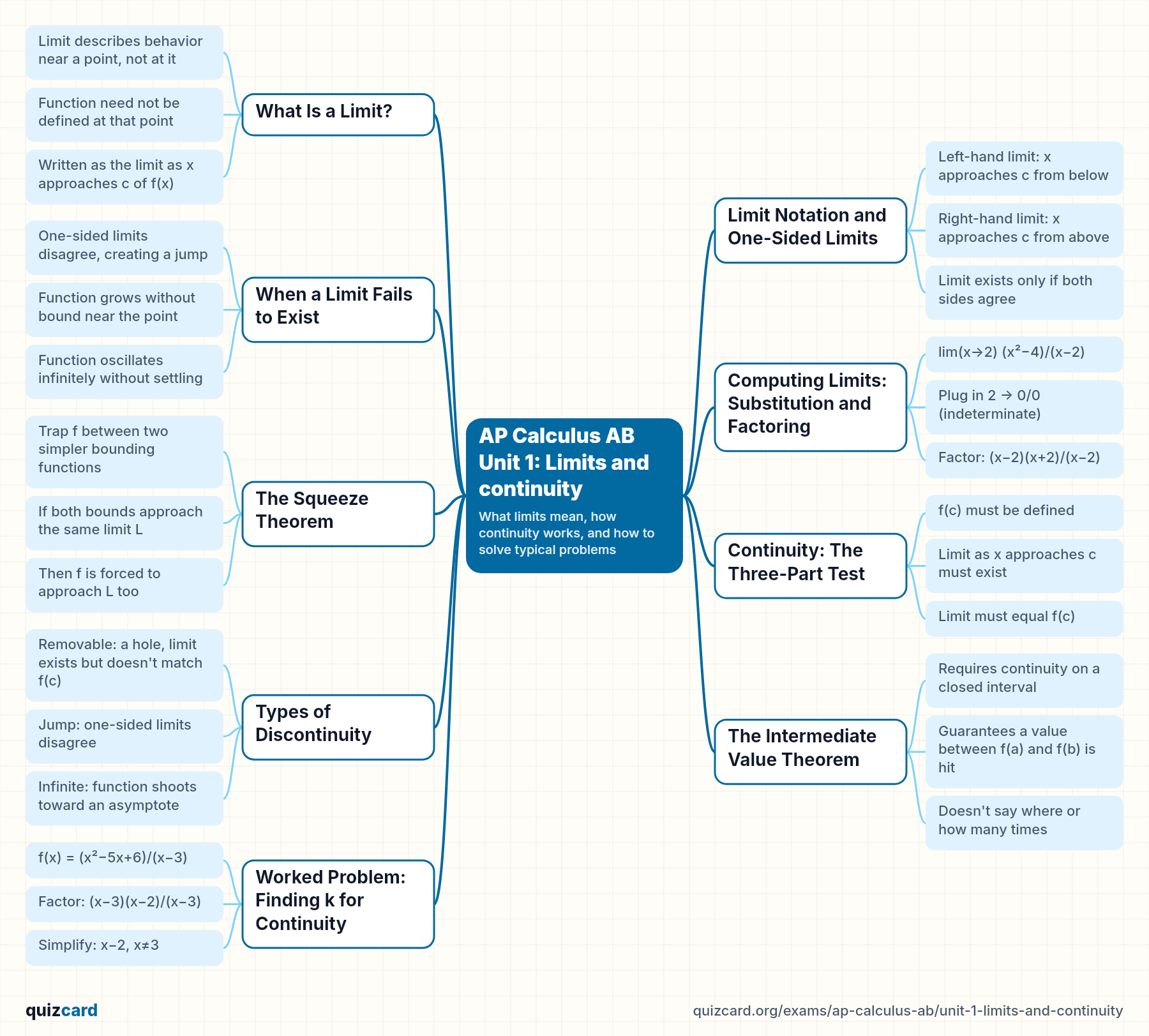
Think a limit just means plugging in the number? That's precisely where most students trip up. In AP Calculus AB, limits describe what a function approaches, not what it equals. We'll cover notation, why limits fail to exist, continuity's test, and solve a typical question step by step.
What Is a Limit?
A limit describes what a function approaches as the input gets closer and closer to some value, even if the function never actually reaches it. Take f of x equals x squared: as x approaches 2, f of x approaches 4, whether or not f is even defined at 2. That distinction, between approaching and equaling, is the entire idea behind calculus.
The limit of f(x) as x approaches c is L if f(x) gets arbitrarily close to L as x gets arbitrarily close to c. Definition of a Limit
Key points.
- Limit describes behavior near a point, not at it
- Function need not be defined at that point
- Written as the limit as x approaches c of f(x)
- Core idea behind all of calculus
Limit Notation and One-Sided Limits
Limits can be approached from the left or the right, written with a tiny plus or minus sign next to c. Consider a function defined as x for inputs below 1 and 2 for inputs at or above 1. As x approaches 1 from the left, the function approaches 1; from the right, it approaches 2. Since those one-sided limits disagree, the overall limit at 1 does not exist.
Key points.
- Left-hand limit: x approaches c from below
- Right-hand limit: x approaches c from above
- Limit exists only if both sides agree
- Notation uses a small plus or minus by c
When a Limit Fails to Exist
A limit fails to exist in three classic ways. The one-sided limits can disagree, producing a jump in the graph. The function can grow without bound, like 1 over x squared as x approaches 0, which shoots off toward infinity on both sides. Or the function can oscillate infinitely fast near the point, the way sine of 1 over x does, never settling toward any single value.
Key points.
- One-sided limits disagree, creating a jump
- Function grows without bound near the point
- Function oscillates infinitely without settling
- All three mean no limit exists
Computing Limits: Substitution and Factoring
Most limits are computed by simply substituting the value in. For the limit as x approaches 2 of x squared minus 4 over x minus 2, plugging in 2 gives 0 over 0, an indeterminate form needing more work. Factor the numerator into x minus 2 times x plus 2, cancel the common factor, and you're left with x plus 2, which gives 4.
lim(x→2) (x²−4)/(x−2)
Plug in 2 → 0/0 (indeterminate)
Factor: (x−2)(x+2)/(x−2)
Cancel (x−2): lim(x→2) (x+2)
Answer: 4
Key points.
- Try plugging in the value first
- Zero over zero means factor and simplify
- Cancel matching factors in top and bottom
- Then substitute again to get the answer
The Squeeze Theorem
Sometimes a function is too complicated to evaluate directly, so you trap it between two simpler functions sharing the same limit. If g of x is less than or equal to f of x, which is less than or equal to h of x, and both g and h approach the same number L, then f also approaches L. The classic case: x squared times sine of 1 over x approaches 0.
Key points.
- Trap f between two simpler bounding functions
- If both bounds approach the same limit L
- Then f is forced to approach L too
- Classic case: x squared sine of 1 over x
Continuity: The Three-Part Test
A function is continuous at a point c only when three conditions all hold. First, f of c must actually be defined. Second, the limit as x approaches c must exist. Third, that limit must equal f of c itself. A function can satisfy the first two and still fail continuity, for example a graph with a hole at x equals 3 where the limit exists but doesn't match the plotted value.
- f(c) is defined
- The limit as x approaches c exists
- That limit equals f(c)
Types of Discontinuity
Not all discontinuities behave the same way. A removable discontinuity is just a hole in the graph, where the limit exists but doesn't equal the function's value there; you can patch it by redefining that single point. Non-removable discontinuities include jumps, where the one-sided limits disagree, and infinite discontinuities, where the function shoots toward a vertical asymptote; neither can be fixed by changing one point.
Removable
- Hole in the graph
- Limit exists but ≠ f(c)
- Fixable by redefining one point
Non-removable
- Jump: one-sided limits disagree
- Infinite: vertical asymptote
- Cannot be fixed at a single point
The Intermediate Value Theorem
The Intermediate Value Theorem says a function continuous on a closed interval from a to b must hit every value between f of a and f of b somewhere inside. If f of 0 equals negative 1 and f of 2 equals 3, some c between 0 and 2 must satisfy f of c equals 0. The theorem only guarantees existence, never the exact location.
If f is continuous on [a, b] and k lies between f(a) and f(b), there exists c in [a, b] with f(c) = k. Intermediate Value Theorem
Key points.
- Requires continuity on a closed interval
- Guarantees a value between f(a) and f(b) is hit
- Doesn't say where or how many times
- Used to prove a root exists
Worked Problem: Finding k for Continuity
Here's a typical question: let f of x equal x squared minus 5x plus 6 over x minus 3, with f of 3 defined as k. Find k so f is continuous at 3. Factor the numerator into x minus 3 times x minus 2, cancel the x minus 3, and take the limit as x approaches 3 of x minus 2, which is 1. So k equals 1.
f(x) = (x²−5x+6)/(x−3)
Factor: (x−3)(x−2)/(x−3)
Simplify: x−2, x≠3
lim(x→3) (x−2) = 1
k = 1 for continuity
Key points.
- Factor the numerator first
- Cancel the common (x−3) factor
- Evaluate the simplified limit
- Set k equal to that limit
Remember this
The one thing to remember: a limit describes where a function is heading, while continuity asks whether it actually arrives there. Test yourself on spotting discontinuities and computing limits by factoring before tackling AP Calculus AB's unit on limits.
Practice this unit
- Algebra and Geometry: Essential Formulas quiz18 multiple-choice questions with explanations · no account needed
- AP Calculus AB: Limits, Continuity and Derivative Rules quiz15 multiple-choice questions with explanations · no account needed
- Calculus: Derivatives and Integrals30 flashcards · study free
- Algebra and Geometry: Essential Formulas30 flashcards · study free
- AP Calculus AB: Limits, Continuity and Derivative Rules34 flashcards · study free
Every AP Calculus AB deck and quiz: the AP Calculus AB hub.
Other AP Calculus AB unit guides
- Unit 2: Differentiation: definition and fundamental propertiesGuide + video lesson
- Unit 3: Differentiation: composite, implicit and inverse functionsStudy guide
- Unit 4: Contextual applications of differentiationStudy guide
- Unit 5: Analytical applications of differentiationGuide + video lesson
- Unit 6: Integration and accumulation of changeGuide + video lesson
- Unit 7: Differential equationsGuide + video lesson
- Unit 8: Applications of integrationStudy guide
Try it with your own material
Upload a PDF, slides or notes and study the deck in minutes. Making your own cards is free with no limits.