Exam prep · AP Calculus AB · Unit guide
AP Calculus AB Unit 7: Differential equations
Slope fields, separating variables, and exponential models, explained step by step
On the exam: Slope fields, separation of variables, exponential models. 6 to 12%.
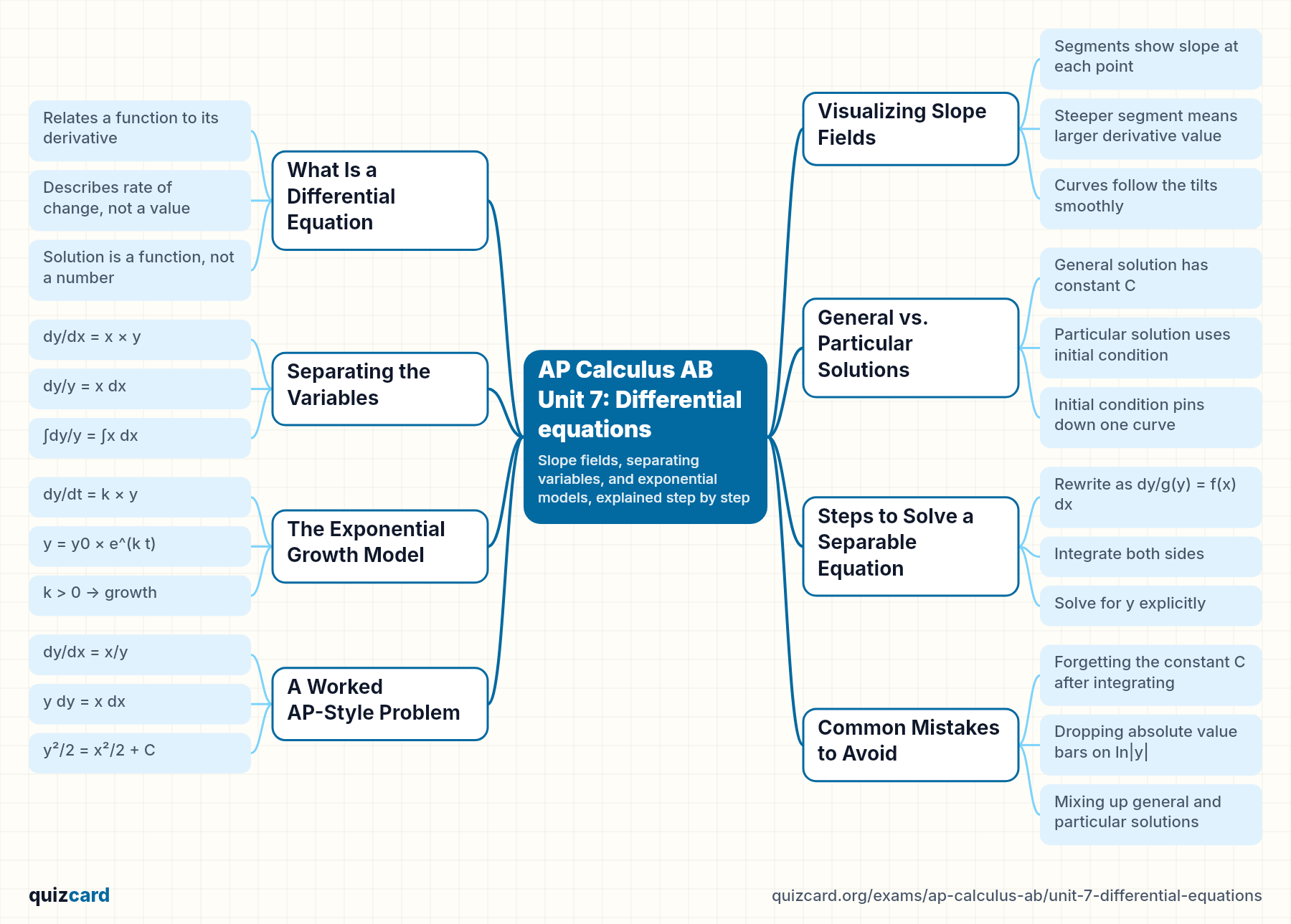
Quick question: if a differential equation has infinitely many solution curves, how do you pick the right one? That mix-up costs students points in AP Calculus AB's unit on differential equations. Here we'll cover slope fields, separating variables, general versus particular solutions, and the exponential growth and decay model.
Watch the lesson
Watch on YouTube · 30-second version
What Is a Differential Equation
A differential equation is simply an equation that contains a derivative, so it describes how something changes rather than stating its value directly. For example, saying the derivative of y with respect to x equals k times y tells you the rate of change is proportional to y itself. Solving a differential equation means finding the actual function y that makes this relationship true, not just a single number.
A differential equation relates a function to its derivative, like dy/dx = ky. AP Calculus AB course framework
Key points.
- Relates a function to its derivative
- Describes rate of change, not a value
- Solution is a function, not a number
Visualizing Slope Fields
A slope field is a picture of a differential equation. At each point on a grid, you draw a short segment whose tilt equals the derivative's value there, found by plugging in the x and y coordinates. For the equation where the derivative equals x times y, the segment at the point one, two has slope two, since one times two equals two. A solution curve simply follows these tilts smoothly across the plane.
Key points.
- Segments show slope at each point
- Steeper segment means larger derivative value
- Curves follow the tilts smoothly
- Used to sketch solutions without solving
Separating the Variables
To solve a separable differential equation, you move all the y terms to one side and all the x terms to the other. Starting with the derivative of y equal to x times y, we rewrite it as dy over y equals x dx. Integrating both sides gives the natural log of the absolute value of y on the left, and x squared over two plus a constant on the right. Exponentiating both sides then gives y equal to a constant times e to the x squared over two.
dy/dx = x × y
dy/y = x dx
∫dy/y = ∫x dx
ln|y| = x²/2 + C
y = A × e^(x²/2)
Key points.
- Separate y terms and x terms
- Integrate both sides separately
- Use ln|y| then exponentiate
- Constant becomes multiplier A
General vs. Particular Solutions
After integrating, you get a general solution that still contains an unknown constant, usually called C, representing an entire family of curves, one for every possible value of C. To find the single curve that fits your situation, you need an initial condition, such as being told y equals three when x equals zero. Plugging that point into the general solution lets you solve for C and pin down the one particular solution that matches.
General Solution
- Contains an arbitrary constant C
- Represents a whole family of curves
- Comes directly from integrating
Particular Solution
- Uses an initial condition for C
- Selects one curve from the family
- Satisfies a specific point like y(0)=3
The Exponential Growth Model
One of the most common differential equations in this unit says the rate of change of a quantity is proportional to the quantity itself, written as the derivative of y with respect to t equal to k times y. Separating variables and integrating gives the familiar exponential model, y equal to y naught times e to the k t, where y naught is the starting amount. When k is positive the quantity grows, like a population increasing each year, and when k is negative it decays, like a radioactive substance losing mass.
dy/dt = k × y
y = y0 × e^(k t)
k > 0 → growth
k < 0 → decay
Key points.
- Rate of change proportional to amount
- Solution: y = y0 e^(kt)
- k>0 growth, k<0 decay
- y0 is value at t=0
Steps to Solve a Separable Equation
When you face a differential equation problem, follow the same routine every time. First, rewrite the equation so every y term sits with dy and every x term sits with dx. Second, integrate both sides. Third, solve for y explicitly if asked, usually by exponentiating to undo a natural log. Fourth, use the given initial condition to solve for the constant C. Finally, write out the particular solution as your answer.
- Rewrite as dy/g(y) = f(x) dx
- Integrate both sides
- Solve for y if possible
- Apply initial condition to find C
- State the particular solution
A Worked AP-Style Problem
Let's work through a typical problem. The derivative of y equals x divided by y, with y of zero equal to negative three. Since it's separable, we write y dy equals x dx, then integrate both sides to get y squared over two equals x squared over two plus a constant. Plugging in x equals zero and y equals negative three gives C equal to four and a half, so y squared equals x squared plus nine. Because y starts negative, we take the negative square root: y equals negative the square root of x squared plus nine.
dy/dx = x/y
y dy = x dx
y²/2 = x²/2 + C
y(0)=−3 → C = 4.5
y² = x² + 9
y = −√(x²+9)
Key points.
- Separate: y dy = x dx
- Integrate: y²/2 = x²/2 + C
- Apply y(0)=−3 to get C=4.5
- Answer: y = −√(x²+9)
Common Mistakes to Avoid
A few mistakes show up again and again. Students forget to add the constant of integration right after integrating, which throws off every later step. Others drop the absolute value bars around the natural log of y, which matters because y can be negative. Many confuse the general solution, the whole family of curves, with the particular solution that satisfies one specific point. And when reading a slope field, remember steepness shows the derivative's value, not which direction the curve moves.
Key points.
- Forgetting the constant C after integrating
- Dropping absolute value bars on ln|y|
- Mixing up general and particular solutions
- Misreading slope steepness as curve direction
Remember this
Remember this: separate the variables, integrate, then use your initial condition to find the particular solution. That's the core skill in AP Calculus AB's differential equations unit. Now quiz yourself on a few problems to lock it in.
Practice this unit
- Algebra and Geometry: Essential Formulas quiz18 multiple-choice questions with explanations · no account needed
- AP Calculus AB: Limits, Continuity and Derivative Rules quiz15 multiple-choice questions with explanations · no account needed
- Calculus: Derivatives and Integrals30 flashcards · study free
- Algebra and Geometry: Essential Formulas30 flashcards · study free
- AP Calculus AB: Limits, Continuity and Derivative Rules34 flashcards · study free
Every AP Calculus AB deck and quiz: the AP Calculus AB hub.
Other AP Calculus AB unit guides
- Unit 1: Limits and continuityStudy guide
- Unit 2: Differentiation: definition and fundamental propertiesGuide + video lesson
- Unit 3: Differentiation: composite, implicit and inverse functionsStudy guide
- Unit 4: Contextual applications of differentiationStudy guide
- Unit 5: Analytical applications of differentiationGuide + video lesson
- Unit 6: Integration and accumulation of changeGuide + video lesson
- Unit 8: Applications of integrationStudy guide
Try it with your own material
Upload a PDF, slides or notes and study the deck in minutes. Making your own cards is free with no limits.