Exam prep · AP Calculus AB · Unit guide
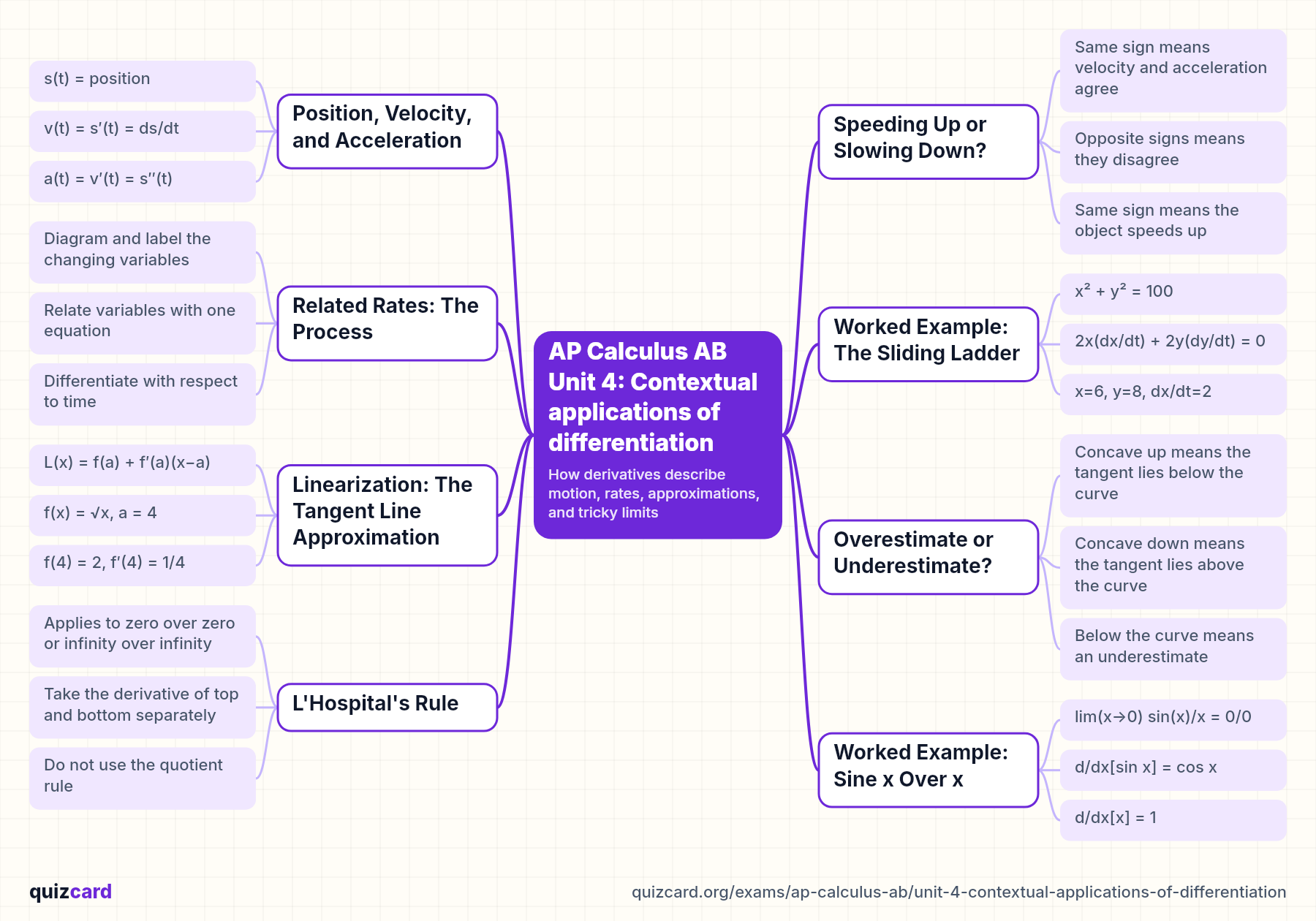
AP Calculus AB Unit 4: Contextual applications of differentiation
How derivatives describe motion, rates, approximations, and tricky limits
On the exam: Related rates, motion, linearization, L’Hospital. 10 to 15%.
Think you can always tell if an object is speeding up just by checking if acceleration is positive? Most AP Calculus AB students get that wrong. This video covers motion along a line, related rates, linearization, and L'Hospital's rule, the unit worth up to fifteen percent of the test.
Position, Velocity, and Acceleration
Let's start with motion along a line. If position is a function of time, call it s of t, then velocity is just its derivative, s prime of t. Acceleration is the derivative of velocity, so the second derivative of position. Speed is simply the absolute value of velocity, since speed can't be negative. Say s of t equals t cubed minus six t squared plus nine t, differentiating once gives velocity, differentiating again gives acceleration.
s(t) = position
v(t) = s′(t) = ds/dt
a(t) = v′(t) = s″(t)
speed = |v(t)|
Key points.
- Velocity is the derivative of position
- Acceleration is the derivative of velocity
- Speed is the absolute value of velocity
- Units tell you what's changing
Speeding Up or Slowing Down?
A common trap is assuming positive acceleration always means speeding up. What actually matters is whether velocity and acceleration share the same sign. If they do, the object is speeding up, because the force keeps pushing it further in the direction it's already moving. If they have opposite signs, the object is slowing down, even if acceleration itself is positive. Always check both signs together, never acceleration alone.
Speeding Up
- Velocity and acceleration same sign
- Object moving faster over time
Slowing Down
- Velocity and acceleration opposite signs
- Object moving slower over time
Related Rates: The Process
Related rates problems connect two or more quantities that change together over time. The method is always the same. First, draw a diagram and label what's changing. Second, find an equation relating those quantities, something like the Pythagorean theorem or a volume formula. Third, differentiate both sides with respect to time, treating every variable as a function of time. Finally, substitute the known values and rates, then solve for the one you don't know.
- Draw a diagram and label changing quantities
- Write an equation relating the variables
- Differentiate both sides with respect to time
- Plug in known values and rates
- Solve for the rate you want
Worked Example: The Sliding Ladder
Here's a typical question. A ten foot ladder leans against a wall, and the base slides away at two feet per second. How fast is the top sliding down when the base is six feet from the wall? Let x be the base distance and y be the height, so x squared plus y squared equals one hundred. Differentiating gives two x times dx dt plus two y times dy dt equals zero. When x is six, y is eight, so solving gives dy dt equals negative one point five feet per second.
x² + y² = 100
2x(dx/dt) + 2y(dy/dt) = 0
x=6, y=8, dx/dt=2
24 + 16(dy/dt) = 0
dy/dt = −1.5 ft/s
Key points.
- Ladder length is fixed at ten feet
- Base slides away at two feet per second
- Use the Pythagorean theorem to relate sides
- Differentiate and solve for the height's rate
Linearization: The Tangent Line Approximation
Linearization uses the tangent line at a point to approximate nearby values of a function. The formula is L of x equals f of a plus f prime of a times x minus a. Take f of x equals the square root of x, with a equals four. Then f of four is two, and f prime of four is one fourth. So L of x equals two plus one fourth times x minus four, which estimates the square root of four point one as about two point zero two five.
L(x) = f(a) + f′(a)(x−a)
f(x) = √x, a = 4
f(4) = 2, f′(4) = 1/4
L(x) = 2 + (1/4)(x−4)
√4.1 ≈ 2.025
Key points.
- Tangent line approximates a function near a point
- Formula uses the function and derivative at a
- Works best very close to that point
- Farther away the approximation gets worse
Overestimate or Underestimate?
One detail examiners love to test is whether the linear approximation overshoots or undershoots the real value. That depends on concavity. If the function is concave up, meaning the second derivative is positive, the tangent line sits below the curve, so the approximation underestimates. If it's concave down, the tangent line sits above the curve, so the approximation overestimates. Always check the sign of the second derivative at that point before answering.
Key points.
- Concave up means the tangent lies below the curve
- Concave down means the tangent lies above the curve
- Below the curve means an underestimate
- Above the curve means an overestimate
L'Hospital's Rule
When a limit gives you zero over zero or infinity over infinity, direct substitution fails, and that's exactly when L'Hospital's rule applies. It says the limit of f over g equals the limit of f prime over g prime, taking each derivative separately rather than using the quotient rule. If the new limit is still indeterminate, you simply apply the rule again. It's a shortcut for limits that algebra alone can't resolve.
If the limit of f over g gives zero over zero or infinity over infinity, it equals the limit of f prime over g prime. L'Hospital's Rule
Key points.
- Applies to zero over zero or infinity over infinity
- Take the derivative of top and bottom separately
- Do not use the quotient rule
- Repeat again if still indeterminate
Worked Example: Sine x Over x
Consider the limit as x approaches zero of sine x over x. Plugging in zero directly gives zero over zero, an indeterminate form, so L'Hospital's rule applies. Differentiate the numerator to get cosine x, and the denominator differentiates to just one. Now take the limit of cosine x over one as x approaches zero, and cosine of zero is one, so the original limit equals one.
lim(x→0) sin(x)/x = 0/0
d/dx[sin x] = cos x
d/dx[x] = 1
lim(x→0) cos(x)/1 = 1
Key points.
- Limit as x approaches zero of sine x over x
- Direct substitution gives zero over zero
- Differentiate numerator and denominator separately
- New limit evaluates directly to one
Remember this
Remember: check whether velocity and acceleration share a sign before calling something speeding up, and trust linear approximations only near the point of tangency. Quiz yourself on these ideas before your AP Calculus AB test to lock them in.
Practice this unit
- Algebra and Geometry: Essential Formulas quiz18 multiple-choice questions with explanations · no account needed
- AP Calculus AB: Limits, Continuity and Derivative Rules quiz15 multiple-choice questions with explanations · no account needed
- Calculus: Derivatives and Integrals30 flashcards · study free
- Algebra and Geometry: Essential Formulas30 flashcards · study free
- AP Calculus AB: Limits, Continuity and Derivative Rules34 flashcards · study free
Every AP Calculus AB deck and quiz: the AP Calculus AB hub.
Other AP Calculus AB unit guides
- Unit 1: Limits and continuityStudy guide
- Unit 2: Differentiation: definition and fundamental propertiesGuide + video lesson
- Unit 3: Differentiation: composite, implicit and inverse functionsStudy guide
- Unit 5: Analytical applications of differentiationGuide + video lesson
- Unit 6: Integration and accumulation of changeGuide + video lesson
- Unit 7: Differential equationsGuide + video lesson
- Unit 8: Applications of integrationStudy guide
Try it with your own material
Upload a PDF, slides or notes and study the deck in minutes. Making your own cards is free with no limits.