Exam prep · AP Chemistry · Unit guide
AP Chemistry Unit 9: Thermodynamics and Electrochemistry
Predict favorability with ΔG, link it to K and E°, and solve cell problems
On the exam: 7 to 9%. Entropy, Gibbs free energy, galvanic and electrolytic cells.
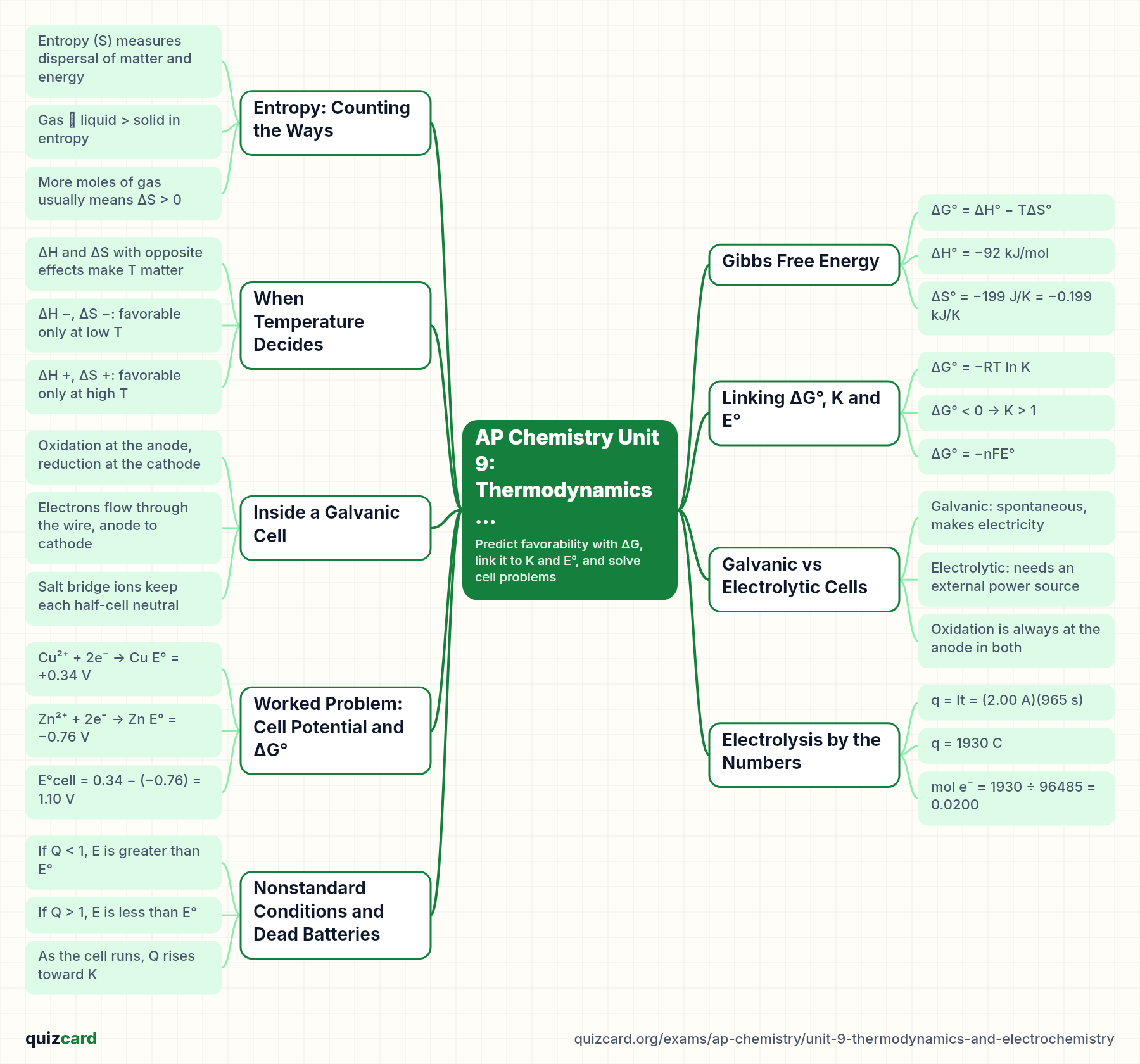
Quick question: if delta G is negative, will the reaction happen fast? Most students say yes, and that's wrong. In this chemistry unit we'll cover entropy, Gibbs free energy, its links to K and cell potential, galvanic and electrolytic cells, and a worked exam-style problem.
Entropy: Counting the Ways
Entropy, written as S, measures how spread out matter and energy are, or how many ways the particles can be arranged. Most of the time you'll predict the sign of delta S rather than calculate it. Gases have far more entropy than liquids, and liquids more than solids, so watch the moles of gas. When calcium carbonate decomposes into calcium oxide and carbon dioxide gas, a gas appears, so delta S is positive.
Key points.
- Entropy (S) measures dispersal of matter and energy
- Gas ≫ liquid > solid in entropy
- More moles of gas usually means ΔS > 0
- CaCO₃(s) → CaO(s) + CO₂(g): ΔS > 0
Gibbs Free Energy
Gibbs free energy combines both driving forces. We write delta G standard equals delta H standard minus T times delta S standard. For making ammonia from nitrogen and hydrogen, delta H is negative ninety-two kilojoules. Delta S is negative one hundred ninety-nine joules per kelvin, which is negative zero point one nine nine kilojoules. Plug in two hundred ninety-eight kelvin, and delta G comes out around negative thirty-three kilojoules, so it's favorable.
ΔG° = ΔH° − TΔS°
ΔH° = −92 kJ/mol
ΔS° = −199 J/K = −0.199 kJ/K
ΔG° = −92 − (298)(−0.199)
ΔG° ≈ −33 kJ/mol
Key points.
- ΔG° = ΔH° − TΔS° decides thermodynamic favorability
- ΔG° < 0 means thermodynamically favorable
- Convert ΔS° from J to kJ before combining
- Ammonia synthesis: ΔG° ≈ −33 kJ/mol at 298 K
When Temperature Decides
The signs of delta H and delta S tell you how temperature matters. If both help, the reaction is favorable at every temperature, and if both hurt, it never is. When they disagree, temperature decides. Ammonia synthesis has both negative, so it's favorable only below about four hundred sixty kelvin. And remember the trap: a favorable reaction can still be extremely slow if its activation energy is high, like diamond turning to graphite.
Temperature doesn't matter
- ΔH −, ΔS +: favorable at all T
- ΔH +, ΔS −: unfavorable at all T
Temperature decides
- ΔH −, ΔS −: favorable at low T
- ΔH +, ΔS +: favorable at high T
Linking ΔG°, K and E°
Free energy connects to equilibrium through delta G standard equals negative R T natural log of K. So if delta G standard is negative, K is greater than one and products are favored at equilibrium. It also connects to electrochemistry through delta G standard equals negative n F E standard, where n is moles of electrons and F is Faraday's constant. Putting these together, a positive E standard means negative delta G and K greater than one.
ΔG° = −RT ln K
ΔG° < 0 → K > 1
ΔG° = −nFE°
E° > 0 → ΔG° < 0 → K > 1
Key points.
- ΔG° = −RT ln K
- Negative ΔG° means K > 1, products favored
- ΔG° = −nFE°
- Positive E° means negative ΔG° and K > 1
Inside a Galvanic Cell
A galvanic cell turns a favorable redox reaction into electric current. In the zinc and copper cell, zinc metal is oxidized at the anode and copper two plus ions are reduced at the cathode. A handy memory aid is an ox and a red cat. Electrons travel through the wire from anode to cathode, while the salt bridge sends anions toward the anode and cations toward the cathode, keeping both sides neutral.
Key points.
- Oxidation at the anode, reduction at the cathode
- Electrons flow through the wire, anode to cathode
- Salt bridge ions keep each half-cell neutral
- Zn anode loses mass; Cu cathode gains mass
Galvanic vs Electrolytic Cells
Students often mix these two up, so let's set them side by side. A galvanic cell runs on its own, with a positive cell potential and negative delta G, turning chemical energy into electrical energy. An electrolytic cell needs an outside power source to force a nonspontaneous reaction, like electroplating. In both, oxidation happens at the anode. What changes is the sign: the anode is negative in galvanic cells and positive in electrolytic ones.
Galvanic (voltaic)
- Spontaneous: E°cell > 0, ΔG < 0
- Chemical energy → electrical energy
- Anode is negative
Electrolytic
- Nonspontaneous: needs external source
- Electrical energy → chemical energy
- Anode is positive
Worked Problem: Cell Potential and ΔG°
Here's a typical exam question. Using the standard reduction potentials for copper, plus zero point three four volts, and zinc, negative zero point seven six volts, find E cell and delta G standard. Copper has the higher potential, so it's the cathode. E cell is zero point three four minus negative zero point seven six, which is one point one zero volts. Then delta G is negative two times ninety-six thousand four hundred eighty-five times one point one zero, about negative two hundred twelve kilojoules.
Cu²⁺ + 2e⁻ → Cu   E° = +0.34 V
Zn²⁺ + 2e⁻ → Zn   E° = −0.76 V
E°cell = 0.34 − (−0.76) = 1.10 V
ΔG° = −(2)(96485)(1.10)
ΔG° ≈ −2.12×10⁵ J ≈ −212 kJ
Key points.
- Cathode: higher reduction potential (Cu²⁺/Cu)
- E°cell = E°cathode − E°anode = 1.10 V
- Never multiply E° by coefficients
- ΔG° = −nFE° ≈ −212 kJ/mol
Electrolysis by the Numbers
Electrolysis problems always follow the same path from current to grams. Say you run two point zero zero amps for nine hundred sixty-five seconds to plate copper. Charge equals current times time, so q is nineteen hundred thirty coulombs. Divide by Faraday's constant to get zero point zero two zero zero moles of electrons. Copper needs two electrons per atom, giving zero point zero one zero zero moles, which is about zero point six three six grams.
q = It = (2.00 A)(965 s)
q = 1930 C
mol e⁻ = 1930 ÷ 96485 = 0.0200
mol Cu = 0.0200 ÷ 2 = 0.0100
mass = 0.0100 × 63.55 ≈ 0.636 g
Key points.
- Charge: q = It, in coulombs
- Moles of electrons = q ÷ 96,485 C/mol
- Use the half-reaction to convert to moles of metal
- 2.00 A for 965 s plates about 0.636 g Cu
Nonstandard Conditions and Dead Batteries
Real cells rarely sit at standard conditions, and you'll usually reason about this qualitatively. If the reaction quotient Q is less than one, there are relatively more reactants, so the cell potential is larger than the standard value. If Q is greater than one, it's smaller. As a battery discharges, products build up and Q climbs toward K. When Q equals K, delta G and the cell potential both hit zero, and the battery is dead.
As a cell runs, Q rises toward K; at equilibrium, ΔG = 0 and E = 0, and the battery is dead. The Nernst relationship
Key points.
- If Q < 1, E is greater than E°
- If Q > 1, E is less than E°
- As the cell runs, Q rises toward K
- At equilibrium, ΔG = 0 and E = 0
Remember this
If you remember one thing, it's this chain: positive E standard means negative delta G, which means K greater than one, but says nothing about speed. Now quiz yourself on these ideas to see what sticks.
Practice this unit
- Chemistry: Atomic Structure and Periodic Trends quiz13 multiple-choice questions with explanations · no account needed
- AP Chemistry: Kinetics, Thermochemistry and Electrochemistry quiz15 multiple-choice questions with explanations · no account needed
- AP Chemistry: Equilibrium, Acids and Bases quiz15 multiple-choice questions with explanations · no account needed
- Chemistry: Atomic Structure and Periodic Trends30 flashcards · study free
- Chemistry: Stoichiometry and Chemical Reactions30 flashcards · study free
- AP Chemistry: Kinetics, Thermochemistry and Electrochemistry34 flashcards · study free
- AP Chemistry: Equilibrium, Acids and Bases36 flashcards · study free
Every AP Chemistry deck and quiz: the AP Chemistry hub.
Other AP Chemistry unit guides
- Unit 1: Atomic Structure and PropertiesStudy guide
- Unit 2: Compound Structure and PropertiesStudy guide
- Unit 3: Properties of Substances and MixturesGuide + video lesson
- Unit 4: Chemical ReactionsGuide + video lesson
- Unit 5: KineticsStudy guide
- Unit 6: ThermochemistryStudy guide
- Unit 7: EquilibriumStudy guide
- Unit 8: Acids and BasesStudy guide
Try it with your own material
Upload a PDF, slides or notes and study the deck in minutes. Making your own cards is free with no limits.