Exam prep · AP Chemistry · Unit guide
AP Chemistry Unit 8: Acids and Bases
How to find pH for strong and weak acids, how buffers work, and how to read a titration curve
On the exam: 11 to 15%. pH, weak acids and bases, buffers, titration curves.
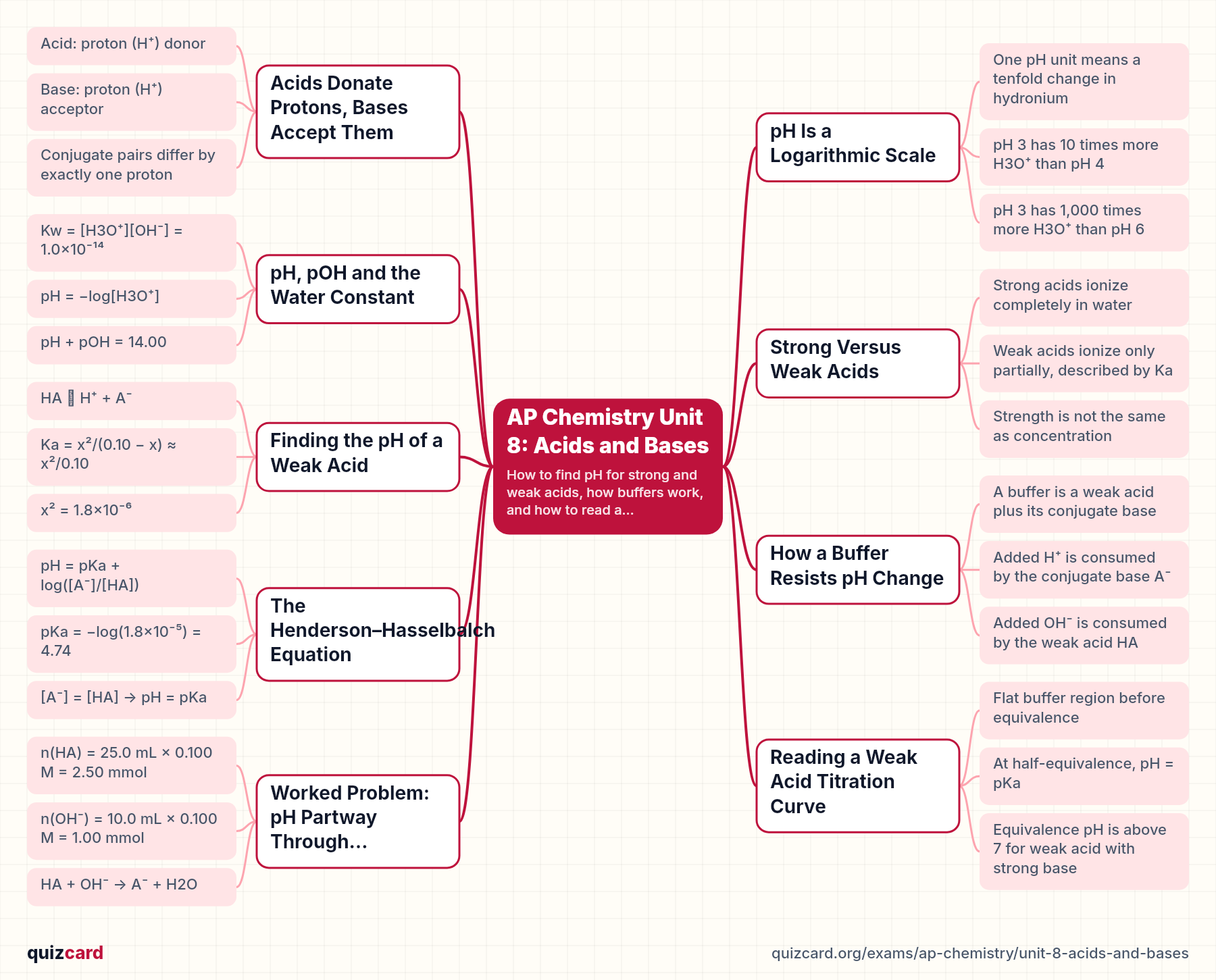
Why isn't the pH at the equivalence point of a weak acid titration equal to seven? That trips up a lot of people in chemistry class. We'll build up from proton transfer and pH to weak acids, buffers and titration curves, then solve a classic problem together.
Acids Donate Protons, Bases Accept Them
Let's start with the definition you'll use all unit long. In the Brønsted–Lowry model, an acid donates a proton and a base accepts one. When acetic acid gives a proton to water, it becomes acetate, its conjugate base, and water becomes hydronium, its conjugate acid. Every acid–base reaction has two of these conjugate pairs, and the partners in each pair differ by exactly one proton.
A Brønsted–Lowry acid is a proton donor; a Brønsted–Lowry base is a proton acceptor. Brønsted–Lowry definition
Key points.
- Acid: proton (H⁺) donor
- Base: proton (H⁺) acceptor
- Conjugate pairs differ by exactly one proton
pH Is a Logarithmic Scale
Because pH is a logarithmic scale, it's easy to underestimate how big a small change is. Each one-unit drop in pH means ten times more hydronium ion. So a solution at pH three has ten times the hydronium concentration of one at pH four, and a thousand times that of one at pH six. Whenever you compare two pH values, think in powers of ten.
10× Change in hydronium concentration for every one-unit change in pH
Key points.
- One pH unit means a tenfold change in hydronium
- pH 3 has 10 times more H3O⁺ than pH 4
- pH 3 has 1,000 times more H3O⁺ than pH 6
pH, pOH and the Water Constant
Water autoionizes slightly, so at twenty-five degrees Celsius, K w, the hydronium concentration times the hydroxide concentration, equals one point zero times ten to the minus fourteen. Next we define pH as the negative log of the hydronium concentration. It follows that pH plus pOH equals fourteen. Now take zero point zero one zero molar hydrochloric acid, so hydronium is zero point zero one zero molar, and the negative log of that gives a pH of two point zero zero.
Kw = [H3O⁺][OH⁻] = 1.0×10⁻¹⁴
pH = −log[H3O⁺]
pH + pOH = 14.00
0.010 M HCl → [H3O⁺] = 0.010 M
pH = −log(0.010) = 2.00
Key points.
- Kw = [H3O⁺][OH⁻] = 1.0×10⁻¹⁴ at 25 °C
- pH = −log[H3O⁺] and pH + pOH = 14.00
- 0.010 M HCl gives pH 2.00
Strong Versus Weak Acids
Strong and weak describe how much an acid ionizes, not how concentrated it is. A strong acid like hydrochloric or nitric acid ionizes completely, so the hydronium concentration simply equals the acid concentration. A weak acid like acetic or hydrofluoric acid ionizes only partially and sets up an equilibrium described by K a. That's why weak acids need an equilibrium setup, while strong acids don't.
Strong acid
- Ionizes completely in water
- HCl, HBr, HI, HNO3, HClO4, H2SO4
- [H3O⁺] equals the acid concentration
- Conjugate base has negligible basicity
Weak acid
- Ionizes partially, reaching equilibrium
- CH3COOH, HF, HNO2
- Find [H3O⁺] with Ka and an ICE table
- Conjugate base is a weak base
Finding the pH of a Weak Acid
Let's find the pH of zero point one zero molar acetic acid, with K a equal to one point eight times ten to the minus five. We write the acid ionizing into hydrogen ion and acetate. K a equals x squared over zero point one zero minus x, and since K a is small, we drop the minus x. So x squared is one point eight times ten to the minus six, x is one point three times ten to the minus three molar, and the pH is two point eight seven.
HA ⇌ H⁺ + A⁻
Ka = x²/(0.10 − x) ≈ x²/0.10
x² = 1.8×10⁻⁶
x = [H⁺] = 1.3×10⁻³ M
pH = 2.87
Key points.
- Set up Ka = x² / (C − x)
- Assume x is small when Ka is small
- 0.10 M acetic acid has pH 2.87
How a Buffer Resists pH Change
A buffer is a mixture of a weak acid and its conjugate base in similar amounts, such as acetic acid and sodium acetate. If you add strong acid, the acetate ions grab those protons and turn into acetic acid. If you add strong base, acetic acid neutralizes the hydroxide and becomes acetate. The pH barely moves, and the more of both components you have, the greater the buffer's capacity.
Key points.
- A buffer is a weak acid plus its conjugate base
- Added H⁺ is consumed by the conjugate base A⁻
- Added OH⁻ is consumed by the weak acid HA
- More of both means greater buffer capacity
The Henderson–Hasselbalch Equation
To find a buffer's pH, write pH equals pK a plus the log of the base concentration over the acid concentration. For acetic acid, pK a is the negative log of one point eight times ten to the minus five, which is four point seven four. When base and acid are equal, the log term is zero, so pH equals pK a. If the ratio is two, you add log two, about zero point three zero, giving a pH of five point zero four.
pH = pKa + log([A⁻]/[HA])
pKa = −log(1.8×10⁻⁵) = 4.74
[A⁻] = [HA] → pH = pKa
[A⁻]/[HA] = 2 → pH = 4.74 + 0.30
pH = 5.04
Key points.
- pH = pKa + log([A⁻]/[HA])
- Equal amounts of A⁻ and HA give pH = pKa
- Doubling the base-to-acid ratio adds 0.30 to pH
Reading a Weak Acid Titration Curve
Picture a weak acid titrated with strong base. The pH starts higher than it would for a strong acid, then rises slowly through a flat buffer region. Halfway to equivalence, acid and conjugate base are equal, so pH equals pK a. At equivalence only acetate remains, and because acetate is a weak base, the pH is above seven. That's why you choose an indicator like phenolphthalein, which changes color in that range.
Key points.
- Flat buffer region before equivalence
- At half-equivalence, pH = pKa
- Equivalence pH is above 7 for weak acid with strong base
- Pick an indicator whose pKa is near the equivalence pH
Worked Problem: pH Partway Through a Titration
Twenty-five milliliters of zero point one molar acetic acid is titrated with zero point one molar sodium hydroxide; what's the pH after ten milliliters? The acid starts at two point five millimoles, and one millimole of hydroxide reacts completely, leaving one point five millimoles of acid and one of acetate. So pH is four point seven four plus the log of one over one point five, which is four point five six.
n(HA) = 25.0 mL × 0.100 M = 2.50 mmol
n(OH⁻) = 10.0 mL × 0.100 M = 1.00 mmol
HA + OH⁻ → A⁻ + H2O
HA = 1.50 mmol, A⁻ = 1.00 mmol
pH = 4.74 + log(1.00/1.50)
pH = 4.74 − 0.18 = 4.56
Key points.
- Convert volumes to moles of acid and base
- Strong base reacts completely with the weak acid
- Use leftover HA and formed A⁻ in Henderson–Hasselbalch
- Answer: pH = 4.56
Remember this
If you remember one thing, make it this: a strong base reacts completely first, then whatever's left decides the pH. Now quiz yourself on these problems until each step feels automatic.
Practice this unit
- Chemistry: Atomic Structure and Periodic Trends quiz13 multiple-choice questions with explanations · no account needed
- AP Chemistry: Kinetics, Thermochemistry and Electrochemistry quiz15 multiple-choice questions with explanations · no account needed
- AP Chemistry: Equilibrium, Acids and Bases quiz15 multiple-choice questions with explanations · no account needed
- Chemistry: Atomic Structure and Periodic Trends30 flashcards · study free
- Chemistry: Stoichiometry and Chemical Reactions30 flashcards · study free
- AP Chemistry: Kinetics, Thermochemistry and Electrochemistry34 flashcards · study free
- AP Chemistry: Equilibrium, Acids and Bases36 flashcards · study free
Every AP Chemistry deck and quiz: the AP Chemistry hub.
Other AP Chemistry unit guides
- Unit 1: Atomic Structure and PropertiesStudy guide
- Unit 2: Compound Structure and PropertiesStudy guide
- Unit 3: Properties of Substances and MixturesGuide + video lesson
- Unit 4: Chemical ReactionsGuide + video lesson
- Unit 5: KineticsStudy guide
- Unit 6: ThermochemistryStudy guide
- Unit 7: EquilibriumStudy guide
- Unit 9: Thermodynamics and ElectrochemistryStudy guide
Try it with your own material
Upload a PDF, slides or notes and study the deck in minutes. Making your own cards is free with no limits.