Exam prep · AP Chemistry · Unit guide
AP Chemistry Unit 5: Kinetics
Rate laws, mechanisms, and catalysis explained the way AP Chemistry tests them
On the exam: 7 to 9%. Rate laws, mechanisms, catalysis.
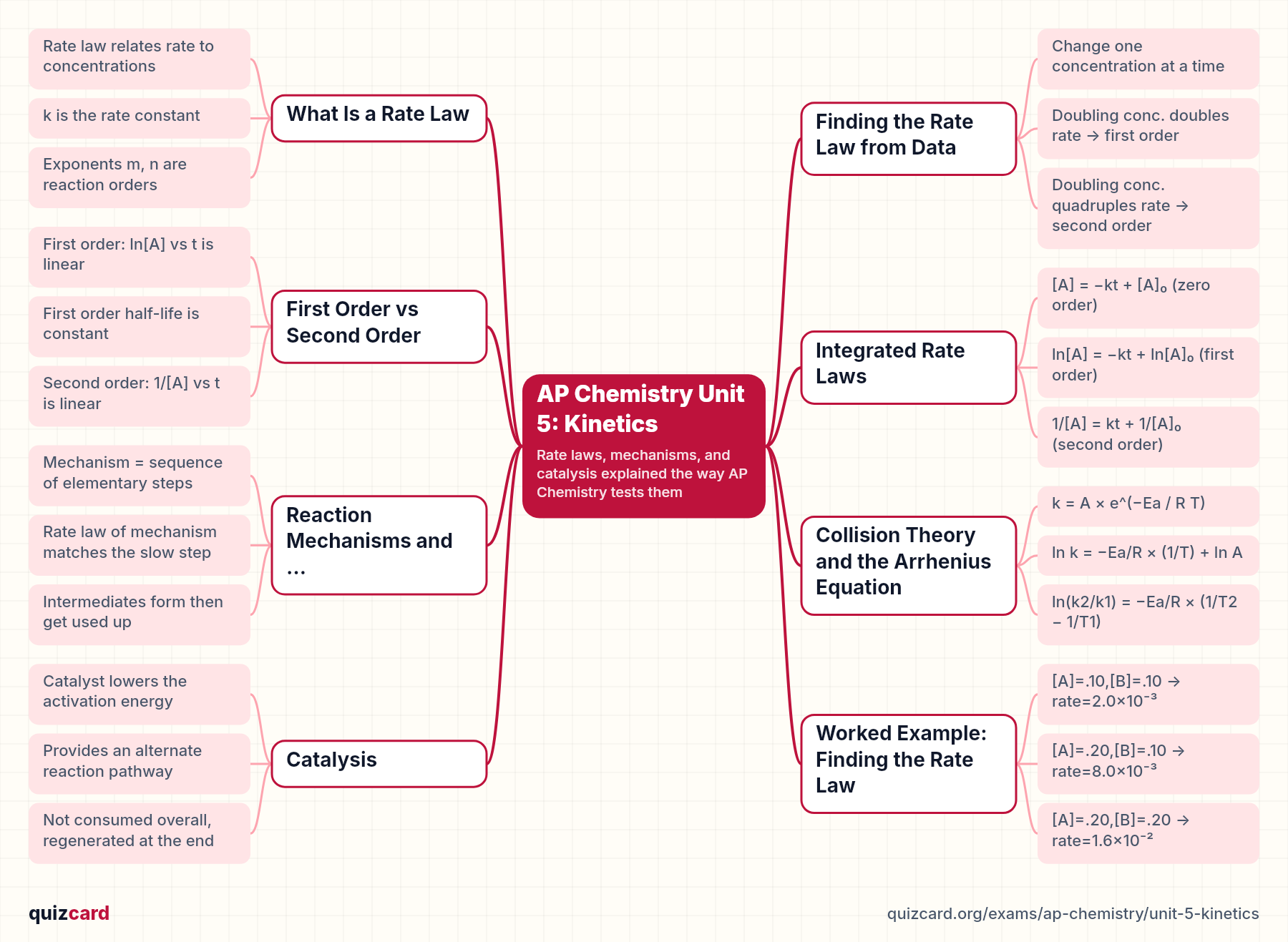
Think you can write a rate law just by looking at the balanced equation? That's the one mistake that costs students points in AP Chemistry. This video walks through rate laws, how mechanisms predict them, the integrated rate equations, and catalysis, then solves a typical kinetics problem.
What Is a Rate Law
A rate law tells you how fast a reaction goes based on concentrations. For a reaction between A and B, you might write rate equals k times concentration of A to some power m times concentration of B to some power n. The constant k is the rate constant, and m and n are the orders, which you can only find from experiment, never just by reading the balanced equation.
Rate = k[A]^m[B]^n, where the exponents m and n are determined experimentally, not from the balanced equation. AP Chemistry Rate Law Definition
Key points.
- Rate law relates rate to concentrations
- k is the rate constant
- Exponents m, n are reaction orders
- Orders come from experiment, not stoichiometry
Finding the Rate Law from Data
To find a rate law, chemists run several trials changing one concentration at a time. If doubling concentration of A doubles the rate, that reactant is first order. If doubling A quadruples the rate, it's second order. Once every exponent is known, plug concentrations and rate from one trial back into the law to solve for k.
- Compare two trials where one concentration changes
- Find how rate changes when that concentration changes
- Match the ratio to find the exponent, the order
- Repeat for each reactant to get full rate law
- Plug values from any trial in to solve for k
First Order vs Second Order
First and second order reactions look alike until you graph them. For first order, plotting the natural log of concentration against time gives a straight line, and the half-life never changes. For second order, plotting one over concentration against time is linear instead, and the half-life gets longer as concentration drops.
First Order
- Half-life stays constant over time
- ln[A] versus time is a straight line
- Half-life equals 0.693 divided by k
Second Order
- Half-life depends on starting concentration
- 1 over [A] versus time is a straight line
- Half-life equals 1 over k times initial concentration
Integrated Rate Laws
For zero order, concentration itself drops in a straight line, equal to negative k t plus the initial concentration. For first order, it's the natural log of concentration that's linear, ln of A equals negative k t plus ln of A initial. For second order, one over concentration is linear, equal to k t plus one over A initial. Only for first order does half-life equal zero point six nine three over k.
[A] = −kt + [A]₀  (zero order)
ln[A] = −kt + ln[A]₀  (first order)
1/[A] = kt + 1/[A]₀  (second order)
t½ = 0.693 / k  (first order only)
Key points.
- Zero order: [A] vs t linear
- First order: ln[A] vs t linear
- Second order: 1/[A] vs t linear
- Half-life formula only simple for first order
Reaction Mechanisms and the Rate-Determining Step
A mechanism is a sequence of elementary steps that add up to the overall reaction. For a single elementary step, you can write its rate law straight from its coefficients. In the reaction of nitrogen dioxide with carbon monoxide, a slow first step forms an intermediate, nitrogen trioxide, and a fast second step consumes it. Since the slow step controls the pace, it sets the rate law for the whole reaction.
Key points.
- Mechanism = sequence of elementary steps
- Rate law of mechanism matches the slow step
- Intermediates form then get used up
- Catalysts appear early, regenerate later
Collision Theory and the Arrhenius Equation
Collision theory says molecules need enough energy and the right orientation to react; raising temperature raises both the number of collisions and the share with enough energy. The Arrhenius equation puts a number on this: k equals A times e to the negative activation energy over R T. Taking the natural log gives a straight line, ln k against one over T, with slope negative activation energy over R.
k = A × e^(−Ea / R T)
ln k = −Ea/R × (1/T) + ln A
ln(k2/k1) = −Ea/R × (1/T2 − 1/T1)
Key points.
- Collisions need enough energy and right orientation
- Higher T → more successful collisions
- k = A·e^(−Ea/RT)
- Plot ln k vs 1/T → slope = −Ea/R
Catalysis
A catalyst speeds up a reaction by opening an alternate pathway with a lower activation energy, so more collisions have enough energy to react even at the same temperature. It shows up in an early elementary step and gets regenerated in a later one, so it never appears in the overall balanced equation and is never consumed. Enzymes in biology and metal surfaces in industrial reactions both work this way.
Key points.
- Catalyst lowers the activation energy
- Provides an alternate reaction pathway
- Not consumed overall, regenerated at the end
- Appears in an early step, cancels out later
Worked Example: Finding the Rate Law
Working through a three-trial data set: from trial one to two, A doubles while B stays fixed, and rate quadruples, so it's second order in A. From trial two to three, B doubles while A stays fixed, and rate only doubles, so it's first order in B. Rate equals k times A squared times B, and trial one gives k equal to two point zero per molar squared per second.
[A]=.10,[B]=.10 → rate=2.0×10⁻³
[A]=.20,[B]=.10 → rate=8.0×10⁻³
[A]=.20,[B]=.20 → rate=1.6×10⁻²
A doubles, rate ×4 → order 2 in A
B doubles, rate ×2 → order 1 in B
k = rate/([A]²[B]) = 2.0 M⁻²s⁻¹
Key points.
- Trial1→2: A×2, rate×4 → order 2
- Trial2→3: B×2, rate×2 → order 1
- Rate = k[A]²[B]
- k = 2.0 M⁻²s⁻¹
Remember this
The one thing to remember: a rate law comes from data or from the slow step of a mechanism, never from the overall balanced equation. For AP Chemistry, quiz yourself on reading initial-rates tables until it's automatic.
Practice this unit
- Chemistry: Atomic Structure and Periodic Trends quiz13 multiple-choice questions with explanations · no account needed
- AP Chemistry: Kinetics, Thermochemistry and Electrochemistry quiz15 multiple-choice questions with explanations · no account needed
- AP Chemistry: Equilibrium, Acids and Bases quiz15 multiple-choice questions with explanations · no account needed
- Chemistry: Atomic Structure and Periodic Trends30 flashcards · study free
- Chemistry: Stoichiometry and Chemical Reactions30 flashcards · study free
- AP Chemistry: Kinetics, Thermochemistry and Electrochemistry34 flashcards · study free
- AP Chemistry: Equilibrium, Acids and Bases36 flashcards · study free
Every AP Chemistry deck and quiz: the AP Chemistry hub.
Other AP Chemistry unit guides
- Unit 1: Atomic Structure and PropertiesStudy guide
- Unit 2: Compound Structure and PropertiesStudy guide
- Unit 3: Properties of Substances and MixturesGuide + video lesson
- Unit 4: Chemical ReactionsGuide + video lesson
- Unit 6: ThermochemistryStudy guide
- Unit 7: EquilibriumStudy guide
- Unit 8: Acids and BasesStudy guide
- Unit 9: Thermodynamics and ElectrochemistryStudy guide
Try it with your own material
Upload a PDF, slides or notes and study the deck in minutes. Making your own cards is free with no limits.