Exam prep · AP Chemistry · Unit guide
AP Chemistry Unit 1: Atomic Structure and Properties
Moles, mass spectrometry, electron configuration, and periodic trends explained simply
On the exam: 7 to 9%. Moles, mass spectrometry, electron configuration, periodic trends.
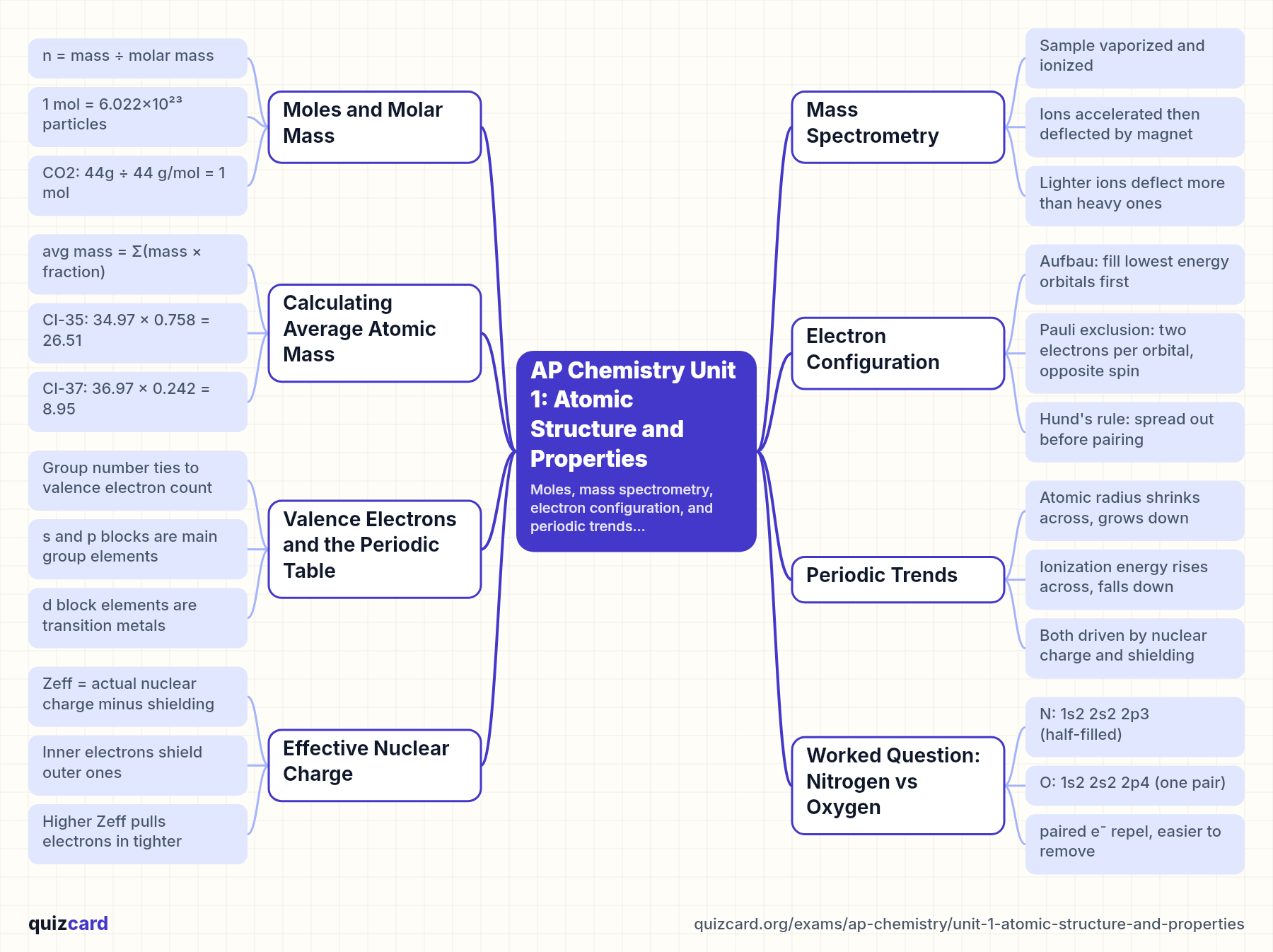
Ever wonder why chemists count atoms in groups of six hundred billion trillion instead of just counting them? In AP Chemistry's Unit 1, we'll cover moles, mass spectrometry, electron configuration, and periodic trends, then work through a question just like you'd see on the exam.
Moles and Molar Mass
The mole is just a counting unit, like a dozen, but enormous: six point zero two two times ten to the twenty-third particles, known as Avogadro's number. To find moles, you divide the mass of a sample in grams by its molar mass in grams per mole. For example, forty-four grams of carbon dioxide, with a molar mass of forty-four grams per mole, gives you exactly one mole, or six point zero two two times ten to the twenty-third molecules.
n = mass ÷ molar mass
1 mol = 6.022×10²³ particles
CO2: 44g ÷ 44 g/mol = 1 mol
1 mol CO2 = 6.022×10²³ molecules
Key points.
- Mole = 6.022×10²³ particles
- Molar mass in grams per mole
- n = mass ÷ molar mass
- Links mass to particle count
Mass Spectrometry
A mass spectrometer identifies isotopes by turning atoms into ions. First the sample is vaporized and bombarded with high energy electrons, knocking off an electron to form a positive ion. An electric field then accelerates these ions, and a magnetic field deflects them, bending lighter ions more sharply than heavier ones. A detector records where each ion lands, producing a spectrum of peaks that show each isotope's mass to charge ratio and its relative abundance.
Key points.
- Sample vaporized and ionized
- Ions accelerated then deflected by magnet
- Lighter ions deflect more than heavy ones
- Detector gives mass-to-charge peaks
Calculating Average Atomic Mass
The periodic table lists the average atomic mass of all naturally occurring isotopes, weighted by how common each one is. Take chlorine: it's about seventy five point eight percent chlorine-35 and twenty four point two percent chlorine-37. You multiply each isotope's mass by its fractional abundance and add the results together. That calculation gives about thirty five point five atomic mass units, which is exactly the value you see on the periodic table for chlorine.
avg mass = Σ(mass × fraction)
Cl-35: 34.97 × 0.758 = 26.51
Cl-37: 36.97 × 0.242 = 8.95
26.51 + 8.95 = 35.45 amu
Key points.
- Average mass = weighted sum of isotopes
- Weight = fractional abundance
- Chlorine-35 and chlorine-37 example
- Result matches periodic table value
Electron Configuration
Writing an electron configuration follows three rules. The aufbau principle says electrons fill the lowest energy orbitals first, following the order you can read straight off the periodic table's blocks. The Pauli exclusion principle limits each orbital to two electrons, and they must have opposite spins. Hund's rule says that within a set of orbitals like the three p orbitals, electrons spread out singly before any pairing happens. Follow those three rules and you can write the configuration for any element, like oxygen's 1s2 2s2 2p4.
- Aufbau: fill lowest energy orbitals first
- Pauli exclusion: max two electrons, opposite spins
- Hund's rule: singly fill before pairing
- Read order from periodic table blocks
Valence Electrons and the Periodic Table
The periodic table is organized by electron configuration, so an element's position tells you a lot about its chemistry. Elements in the same group, like group two or group seventeen, have the same number of valence electrons and behave similarly. Main group elements fill s and p orbitals, while transition metals in the d block fill d orbitals after the preceding s orbital. Sodium and potassium both sit in group one with a single valence electron, which is why both react vigorously, losing that one electron to form plus one ions.
Key points.
- Group number ties to valence electron count
- s and p blocks are main group elements
- d block elements are transition metals
- Valence electrons determine bonding behavior
Periodic Trends
Two trends matter most across the periodic table. Moving left to right across a period, atomic radius shrinks because protons increase but electrons stay in the same shell, pulling them in tighter. Moving down a group, atomic radius grows because each row adds a new electron shell. Ionization energy, the energy needed to remove an electron, does the opposite: it rises across a period as atoms hold electrons more tightly, and it falls down a group because outer electrons sit farther from the nucleus and are easier to remove.
Across a Period
- Atomic radius decreases
- Ionization energy increases
- Electronegativity increases
Down a Group
- Atomic radius increases
- Ionization energy decreases
- Electronegativity decreases
Effective Nuclear Charge
Why do these trends happen at all? The answer is effective nuclear charge, often written zed effective. It equals the actual number of protons minus the shielding provided by inner, core electrons. Across a period, protons increase but shielding stays roughly constant, so effective nuclear charge rises and pulls electrons closer. Down a group, each new shell adds shielding that roughly cancels the added protons, so effective nuclear charge barely changes while electrons simply sit farther away.
Effective nuclear charge equals the actual nuclear charge minus the shielding from core electrons. AP Chemistry periodic trends model
Key points.
- Zeff = actual nuclear charge minus shielding
- Inner electrons shield outer ones
- Higher Zeff pulls electrons in tighter
- Explains why trends happen
Worked Question: Nitrogen vs Oxygen
Here's a question you might actually see: why does oxygen have a lower first ionization energy than nitrogen, even though oxygen has one more proton? Write out the configurations. Nitrogen is 1s2 2s2 2p3, a half-filled and extra stable set of p orbitals. Oxygen is 1s2 2s2 2p4, which forces two electrons into the same p orbital. That paired electron feels extra repulsion from its orbital partner, so it's actually easier to remove, making oxygen's ionization energy lower despite its larger nuclear charge.
N: 1s2 2s2 2p3 (half-filled)
O: 1s2 2s2 2p4 (one pair)
paired e⁻ repel, easier to remove
IE: N > O
Key points.
- N has 1s2 2s2 2p3, half-filled and stable
- O has 1s2 2s2 2p4, one paired electron
- Electron-electron repulsion makes pairing easier to remove
- Result: oxygen's ionization energy is lower than nitrogen's
Remember this
The one thing to remember: an atom's electron configuration dictates its place on the periodic table and therefore its chemical behavior, from ionization energy to atomic radius. Before your AP Chemistry exam, quiz yourself on configurations and trends until they feel automatic.
Practice this unit
- Chemistry: Atomic Structure and Periodic Trends quiz13 multiple-choice questions with explanations · no account needed
- AP Chemistry: Kinetics, Thermochemistry and Electrochemistry quiz15 multiple-choice questions with explanations · no account needed
- AP Chemistry: Equilibrium, Acids and Bases quiz15 multiple-choice questions with explanations · no account needed
- Chemistry: Atomic Structure and Periodic Trends30 flashcards · study free
- Chemistry: Stoichiometry and Chemical Reactions30 flashcards · study free
- AP Chemistry: Kinetics, Thermochemistry and Electrochemistry34 flashcards · study free
- AP Chemistry: Equilibrium, Acids and Bases36 flashcards · study free
Every AP Chemistry deck and quiz: the AP Chemistry hub.
Other AP Chemistry unit guides
- Unit 2: Compound Structure and PropertiesStudy guide
- Unit 3: Properties of Substances and MixturesGuide + video lesson
- Unit 4: Chemical ReactionsGuide + video lesson
- Unit 5: KineticsStudy guide
- Unit 6: ThermochemistryStudy guide
- Unit 7: EquilibriumStudy guide
- Unit 8: Acids and BasesStudy guide
- Unit 9: Thermodynamics and ElectrochemistryStudy guide
Try it with your own material
Upload a PDF, slides or notes and study the deck in minutes. Making your own cards is free with no limits.