Exam prep · AP Chemistry · Unit guide
AP Chemistry Unit 2: Compound Structure and Properties
Learn Lewis structures, VSEPR, and hybridization to predict molecular shape and polarity
On the exam: 7 to 9%. Bonding, Lewis structures, VSEPR, hybridization.
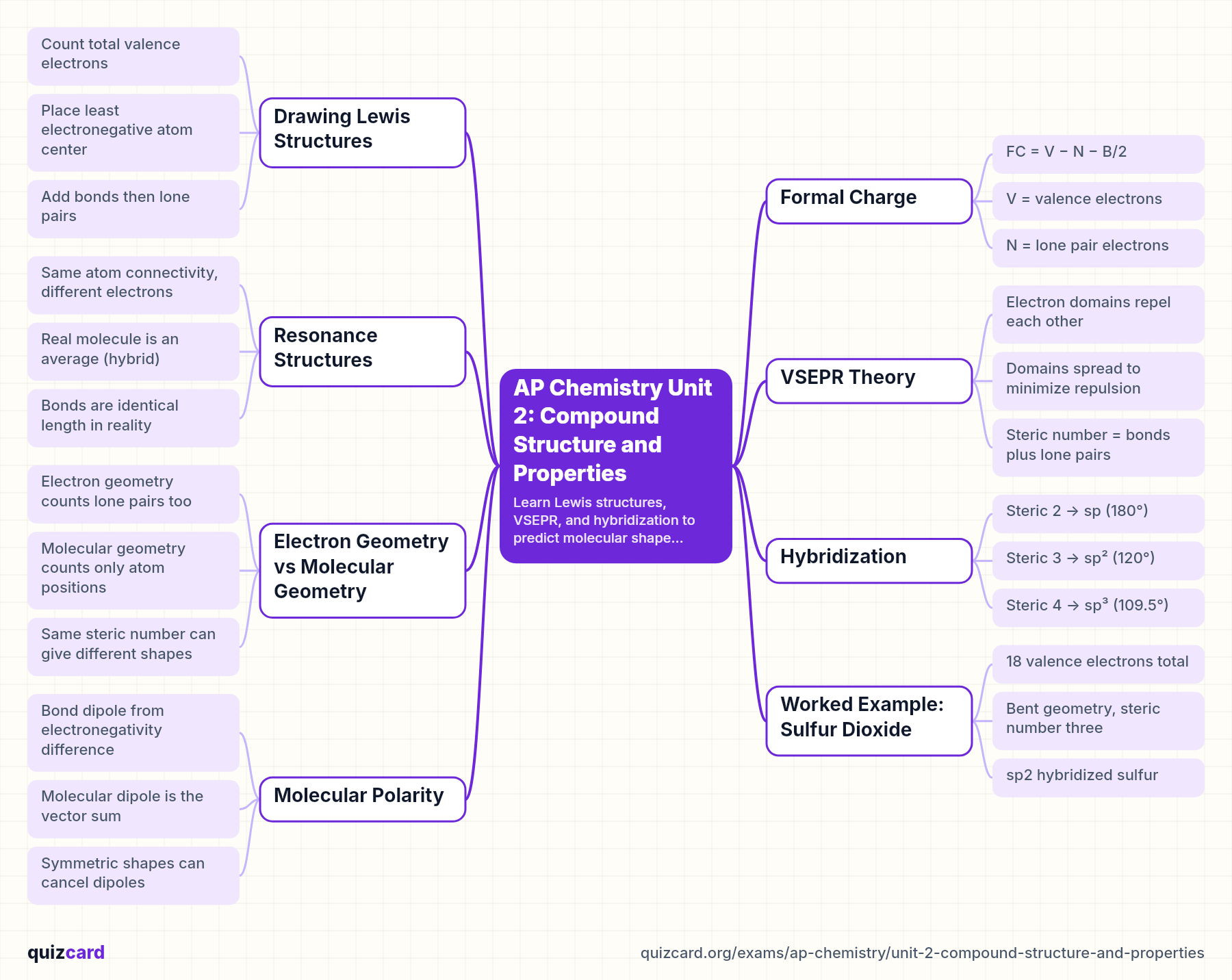
Ever draw a perfect Lewis structure and still guess the wrong molecular shape? That mix-up costs students points throughout AP Chemistry's bonding unit. We'll build Lewis structures, use formal charge and resonance, predict shapes with VSEPR, connect geometry to hybridization, and finish with a full worked example.
Drawing Lewis Structures
Start by counting every valence electron in the molecule, for carbon dioxide that's four from carbon plus six from each oxygen, so sixteen total. Put the least electronegative atom in the center, here carbon, and connect it to the oxygens with single bonds. Then distribute the remaining electrons as lone pairs to satisfy each atom's octet, adding double or triple bonds if the central atom is short of electrons. Carbon dioxide ends up with two carbon-oxygen double bonds and no lone pairs on carbon.
- Count total valence electrons
- Arrange atoms, central atom least electronegative
- Connect atoms with single bonds
- Distribute remaining electrons as lone pairs
- Add multiple bonds to complete octets
Formal Charge
When more than one Lewis structure seems possible, formal charge tells you which one is actually favored. You calculate it for each atom as its valence electrons, minus its lone pair electrons, minus half of its bonding electrons. The best structure keeps formal charges as close to zero as possible, with any negative charge sitting on the most electronegative atom. For carbon dioxide, the structure with two double bonds gives every atom a formal charge of zero, which is why we draw it that way.
FC = V − N − B/2
V = valence electrons
N = lone pair electrons
B = bonding electrons
Best structure: FC near 0
Key points.
- Formula: valence minus nonbonding minus half bonding
- Picks the best resonance structure
- Best structure: charges near zero
- Negative charge goes on most electronegative atom
Resonance Structures
Some molecules can't be captured by just one Lewis structure. Ozone, for instance, has a double bond on one side and a single bond on the other, but you could just as easily draw it the opposite way. Neither drawing is the real molecule, the actual bonds are identical, with a length and strength in between a single and double bond. Chemists call this a resonance hybrid, and both oxygen-oxygen bonds in ozone measure exactly the same, about one hundred twenty-eight picometers.
Resonance structures are multiple valid Lewis structures for one molecule, averaged into a single real structure AP Chemistry definition
Key points.
- Same atom connectivity, different electrons
- Real molecule is an average (hybrid)
- Bonds are identical length in reality
- Example: ozone, carbonate, nitrate
VSEPR Theory
Valence shell electron pair repulsion theory, or VSEPR, says that electron domains around a central atom, whether bonding pairs or lone pairs, arrange themselves as far apart as possible to minimize repulsion. You find the steric number by adding the atoms bonded to the center plus the lone pairs sitting on it. Lone pairs take up more space than bonding pairs, so they squeeze bonding pairs closer together, which is why ammonia's bond angle is about one hundred seven degrees instead of the perfect tetrahedral one hundred nine point five.
Key points.
- Electron domains repel each other
- Domains spread to minimize repulsion
- Steric number = bonds plus lone pairs
- Lone pairs compress bond angles
Electron Geometry vs Molecular Geometry
It's worth separating two terms AP Chemistry tests carefully: electron geometry includes lone pairs, molecular geometry describes only where the atoms sit. Methane, ammonia, and water all have a steric number of four, so all three share a tetrahedral electron geometry. But their molecular geometries differ: methane, with four bonds and no lone pairs, is tetrahedral; ammonia, with three bonds and one lone pair, is trigonal pyramidal; and water, with two bonds and two lone pairs, is bent.
Electron geometry
- Counts bonding and lone pairs
- Tetrahedral, trigonal planar, etc
- Same for CH4, NH3, H2O
Molecular geometry
- Counts only atom positions
- Lone pairs are invisible in shape
- CH4 tetrahedral, NH3 pyramidal, H2O bent
Hybridization
Hybridization explains how an atom's orbitals mix to produce the geometry VSEPR predicts. A steric number of two, as in carbon dioxide, means one s and one p orbital mix into two sp orbitals at a hundred eighty degrees. A steric number of three, like boron trifluoride, gives sp two orbitals at a hundred twenty degrees, and a steric number of four, like methane, gives sp three orbitals at a hundred nine point five degrees. Five and six domains extend this to sp three d and sp three d two.
Steric 2 → sp (180°)
Steric 3 → sp² (120°)
Steric 4 → sp³ (109.5°)
Steric 5 → sp³d (trig bipyr)
Steric 6 → sp³d² (octahedral)
Key points.
- Steric number sets hybridization type
- sp for linear, sp2 for trigonal planar
- sp3 for tetrahedral geometry
- sp3d and sp3d2 beyond period two
Molecular Polarity
A bond is polar whenever two atoms differ in electronegativity, but whether the whole molecule is polar depends on geometry too. Carbon dioxide has two polar carbon-oxygen bonds, but because the molecule is linear, those two dipoles point in exactly opposite directions and cancel, making carbon dioxide nonpolar overall. Water also has two polar bonds, but its bent shape means the dipoles don't cancel, leaving a net dipole moment and making water a polar molecule.
Key points.
- Bond dipole from electronegativity difference
- Molecular dipole is the vector sum
- Symmetric shapes can cancel dipoles
- CO2 nonpolar, H2O polar
Worked Example: Sulfur Dioxide
Let's work through a typical question: find the shape, hybridization, and polarity of sulfur dioxide. Sulfur contributes six valence electrons and each oxygen six more, for eighteen total. The best structure places sulfur in the center with one double bond, one single bond, and one lone pair, giving a steric number of three. That means sp two hybridization and a bent geometry near a hundred nineteen degrees, and since the bond dipoles don't cancel, sulfur dioxide ends up polar.
- Count valence electrons: 6+6+6=18
- Draw S central, one S=O, one S−O, lone pair on S
- Steric number on S equals 3
- Geometry: bent, about 119 degrees
- Hybridization sp2, molecule is polar
Remember this
The one thing to remember: count electron domains first, that single number predicts the shape, the hybridization, and often the polarity of any molecule. Try quizzing yourself on examples like boron trifluoride or xenon tetrafluoride before moving on in your AP Chemistry review.
Practice this unit
- Chemistry: Atomic Structure and Periodic Trends quiz13 multiple-choice questions with explanations · no account needed
- AP Chemistry: Kinetics, Thermochemistry and Electrochemistry quiz15 multiple-choice questions with explanations · no account needed
- AP Chemistry: Equilibrium, Acids and Bases quiz15 multiple-choice questions with explanations · no account needed
- Chemistry: Atomic Structure and Periodic Trends30 flashcards · study free
- Chemistry: Stoichiometry and Chemical Reactions30 flashcards · study free
- AP Chemistry: Kinetics, Thermochemistry and Electrochemistry34 flashcards · study free
- AP Chemistry: Equilibrium, Acids and Bases36 flashcards · study free
Every AP Chemistry deck and quiz: the AP Chemistry hub.
Other AP Chemistry unit guides
- Unit 1: Atomic Structure and PropertiesStudy guide
- Unit 3: Properties of Substances and MixturesGuide + video lesson
- Unit 4: Chemical ReactionsGuide + video lesson
- Unit 5: KineticsStudy guide
- Unit 6: ThermochemistryStudy guide
- Unit 7: EquilibriumStudy guide
- Unit 8: Acids and BasesStudy guide
- Unit 9: Thermodynamics and ElectrochemistryStudy guide
Try it with your own material
Upload a PDF, slides or notes and study the deck in minutes. Making your own cards is free with no limits.