Exam prep · AP Physics 1 · Unit guide
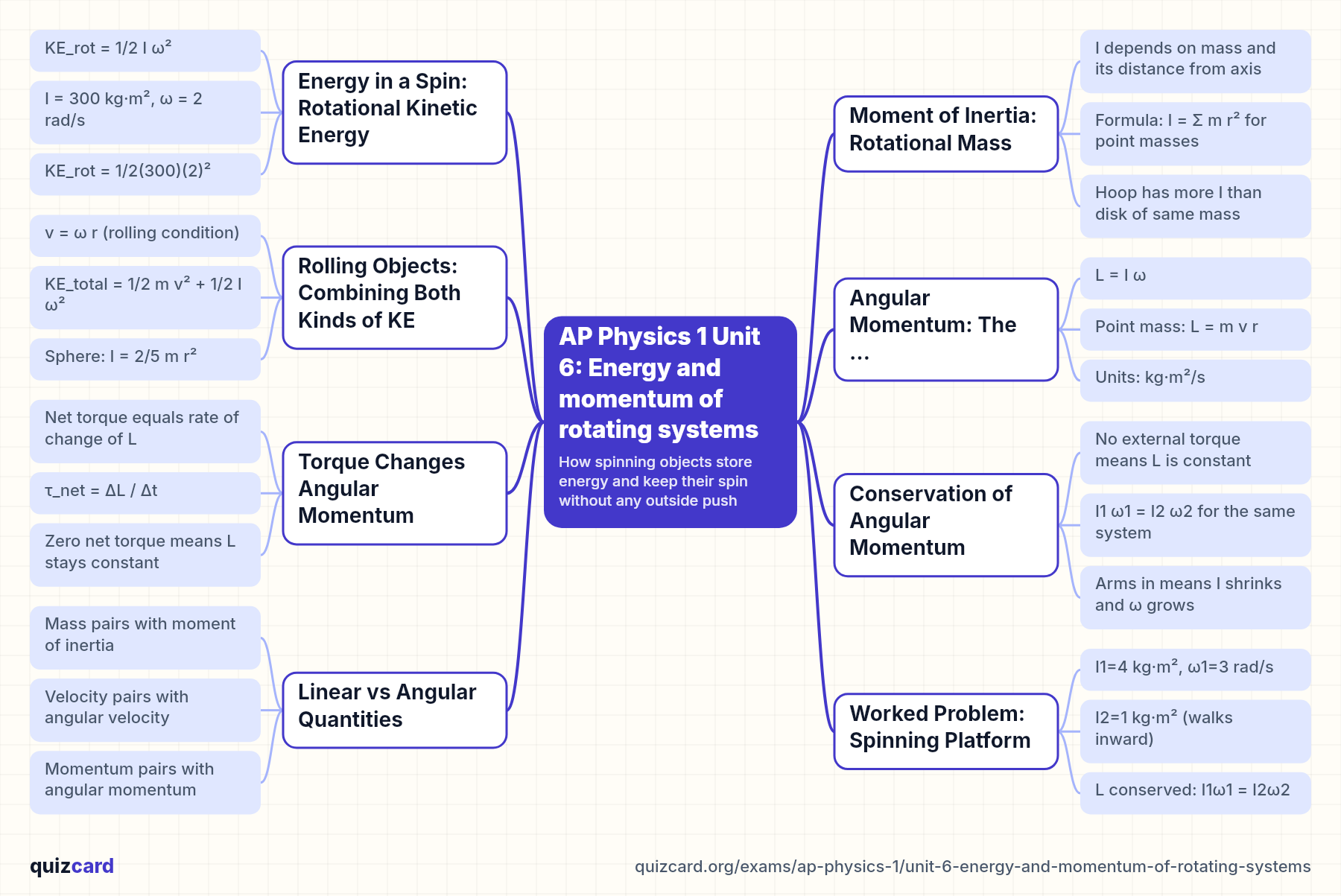
AP Physics 1 Unit 6: Energy and momentum of rotating systems
How spinning objects store energy and keep their spin without any outside push
On the exam: Rotational kinetic energy, angular momentum and its conservation. 5 to 8%.
Ever wonder why a figure skater spins faster when she pulls her arms in, with no one pushing her? That's the single idea many AP Physics 1 students miss about rotating systems. This video covers rotational kinetic energy, moment of inertia, and how angular momentum conservation explains that speed up.
Energy in a Spin: Rotational Kinetic Energy
Just like a moving object carries kinetic energy from its mass and speed, a spinning object carries rotational kinetic energy from its moment of inertia and angular velocity: one half moment of inertia times angular velocity squared. For a merry go round with moment of inertia three hundred kilogram meters squared spinning at two radians per second, that gives six hundred joules.
KE_rot = 1/2 I ω²
I = 300 kg·m², ω = 2 rad/s
KE_rot = 1/2(300)(2)²
KE_rot = 600 J
Key points.
- KE_rot = ½ I ω²
- I is moment of inertia (rotational mass)
- ω is angular velocity in radians per second
- Mirrors linear KE = ½ m v²
Moment of Inertia: Rotational Mass
Moment of inertia measures how hard it is to change an object's spin, and it depends on both how much mass there is and how far that mass sits from the axis of rotation. A ring with all its mass at the rim has a larger moment of inertia than a solid disk of the same mass, because the ring's mass sits farther out.
Key points.
- I depends on mass and its distance from axis
- Formula: I = Σ m r² for point masses
- Hoop has more I than disk of same mass
- Farther mass means harder to start or stop spin
Rolling Objects: Combining Both Kinds of KE
When something rolls without slipping, its center moves forward while it also spins, so it carries two kinds of kinetic energy at once. The rolling condition says the speed equals angular velocity times radius. For a solid sphere, whose moment of inertia is two fifths mass times radius squared, the total kinetic energy works out to seven tenths of mass times velocity squared.
v = ω r (rolling condition)
KE_total = 1/2 m v² + 1/2 I ω²
Sphere: I = 2/5 m r²
KE_total = 7/10 m v²
Key points.
- Rolling without slipping: v = ω r
- Total KE = translational + rotational
- Solid sphere: I = 2/5 m r²
- Total KE = 7/10 m v² for a rolling sphere
Angular Momentum: The Rotational Momentum
Angular momentum is the rotational twin of linear momentum, and for a rigid body spinning about a fixed axis it equals moment of inertia times angular velocity. For a single point mass moving in a circle, you can also write it as mass times velocity times the radius, since that's just inertia times angular speed in disguise. Its units are kilogram meter squared per second.
L = I ω
Point mass: L = m v r
Units: kg·m²/s
Key points.
- L = I ω
- Point mass: L = m v r (perpendicular distance)
- Units: kilogram meter squared per second
- Rotational analog of linear momentum p = m v
Torque Changes Angular Momentum
Just as a net force changes an object's linear momentum over time, a net torque changes its angular momentum over time. If the net external torque acting on a system is zero, there is nothing to change the angular momentum, so it stays exactly constant. This single idea is what lets you predict spin speeds whenever torques balance out or vanish entirely.
Key points.
- Net torque equals rate of change of L
- τ_net = ΔL / Δt
- Zero net torque means L stays constant
- Rotational version of Newton's second law
Conservation of Angular Momentum
Think about a skater spinning with her arms stretched out: her moment of inertia is large, so her angular velocity is modest. When she pulls her arms in, she shrinks her moment of inertia, and since nothing is twisting her from outside, her angular momentum cannot change, so her angular velocity must shoot up instead, and she spins noticeably faster.
When the net external torque on a system is zero, its total angular momentum does not change. Law of Conservation of Angular Momentum
Key points.
- No external torque means L is constant
- I1 ω1 = I2 ω2 for the same system
- Arms in means I shrinks and ω grows
- Classic example: the spinning figure skater
Linear vs Angular Quantities
Every rotational quantity has a straight line partner. Mass becomes moment of inertia, velocity becomes angular velocity, and momentum becomes angular momentum, built the same way but with the rotational versions of mass and speed. Even the energy formulas match: one half mass velocity squared on one side, one half moment of inertia angular velocity squared on the other.
Linear Motion
- Mass, m
- Velocity, v
- Momentum, p = m v
- Kinetic energy = ½ m v²
Rotational Motion
- Moment of inertia, I
- Angular velocity, ω
- Angular momentum, L = I ω
- Kinetic energy = ½ I ω²
Worked Problem: Spinning Platform
A typical problem: a student stands at the edge of a frictionless rotating platform with a moment of inertia of four kilogram meters squared, spinning at three radians per second. She walks toward the center, shrinking the moment of inertia to one kilogram meter squared. Since there's no outside torque, angular momentum is conserved, so four times three equals one times the new angular velocity, giving twelve radians per second.
I1=4 kg·m², ω1=3 rad/s
I2=1 kg·m² (walks inward)
L conserved: I1ω1 = I2ω2
ω2 = (4×3)/1 = 12 rad/s
Key points.
- Student at edge: I1 = 4, ω1 = 3 rad/s
- She walks to center: I2 = 1
- No external torque, so L is conserved
- Solve I1ω1 = I2ω2 for ω2
Remember this
The one thing to remember: when no external torque acts, angular momentum stays constant, so a smaller moment of inertia means a faster spin. For AP Physics 1, quiz yourself on rotational kinetic energy and angular momentum before moving on.
Practice this unit
- MCAT Physics: Fluids, Circuits, Waves and Optics Formulas quiz15 multiple-choice questions with explanations · no account needed
- AP Physics 1: Energy, Momentum and Rotation quiz15 multiple-choice questions with explanations · no account needed
- Physics: Kinematics and Newton's Laws25 flashcards · study free
- Physics: Electricity and Circuits27 flashcards · study free
- MCAT Physics: Fluids, Circuits, Waves and Optics Formulas39 flashcards · study free
- AP Physics 1: Energy, Momentum and Rotation38 flashcards · study free
Every AP Physics 1 deck and quiz: the AP Physics 1 hub.
Other AP Physics 1 unit guides
- Unit 1: KinematicsStudy guide
- Unit 2: Force and translational dynamicsStudy guide
- Unit 3: Work, energy and powerStudy guide
- Unit 4: Linear momentumGuide + video lesson
- Unit 5: Torque and rotational dynamicsStudy guide
- Unit 7: OscillationsStudy guide
- Unit 8: FluidsStudy guide
Try it with your own material
Upload a PDF, slides or notes and study the deck in minutes. Making your own cards is free with no limits.