Exam prep · AP Physics 1 · Unit guide
AP Physics 1 Unit 1: Kinematics
Learn to read motion graphs, apply the kinematic equations, and solve projectile problems
On the exam: Motion in one and two dimensions, graphs of motion. 10 to 15% of the exam.
What's the one mistake that trips up most students in the kinematics unit of AP Physics 1? They mix up velocity with speed, or misread a graph's slope as a distance. This video covers position, velocity, acceleration, motion graphs, the kinematic equations, free fall, and projectile motion, finishing with a worked problem.
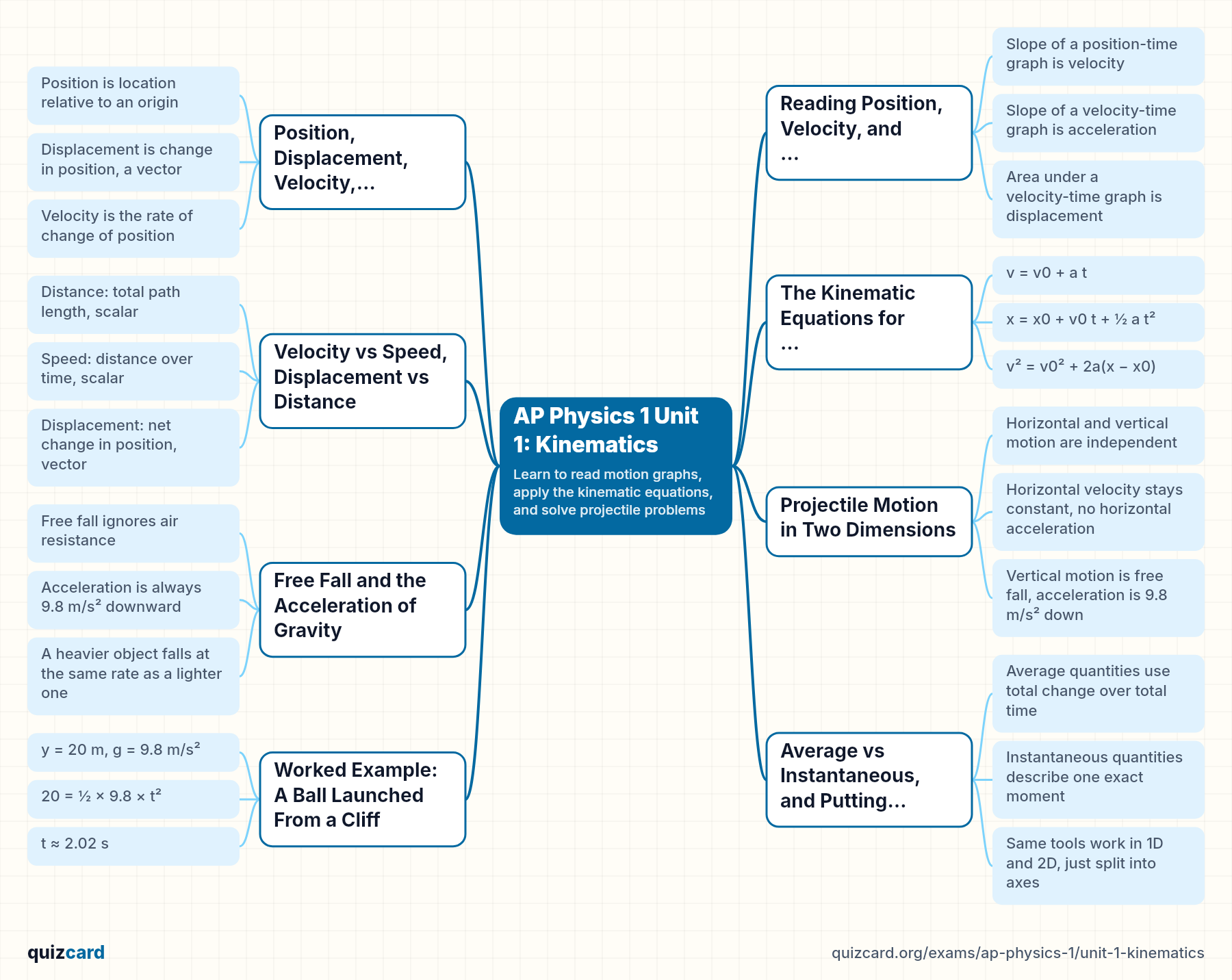
Position, Displacement, Velocity, and Acceleration
Kinematics starts with four quantities. Position is where an object is relative to an origin you choose. Displacement is the change in position, a vector, so direction matters, not just how far something traveled. Velocity is the rate of change of position, in meters per second. Acceleration is the rate of change of velocity, in meters per second squared. Keep these straight and the rest of the unit follows.
Key points.
- Position is location relative to an origin
- Displacement is change in position, a vector
- Velocity is the rate of change of position
- Acceleration is the rate of change of velocity
Reading Position, Velocity, and Acceleration Graphs
Graphs hide the calculus in plain sight. On a position versus time graph, the slope at any point is the instantaneous velocity, so a curved line means the object is accelerating. On a velocity versus time graph, the slope gives acceleration, and the area under the line gives displacement. A velocity graph sitting flat at five meters per second for four seconds, for instance, means a displacement of twenty meters.
Key points.
- Slope of a position-time graph is velocity
- Slope of a velocity-time graph is acceleration
- Area under a velocity-time graph is displacement
- Area under an acceleration-time graph is change in velocity
Velocity vs Speed, Displacement vs Distance
AP questions test this constantly. Distance and speed are scalars, they only track how much ground you covered, so a runner completing one lap of a four hundred meter track has traveled four hundred meters. Displacement and velocity are vectors, they track your net change in position, so that same runner, ending where she started, has a displacement of zero and an average velocity of zero, despite moving the whole time.
Vector Quantities
- Displacement: straight-line change in position
- Velocity: displacement over time, has direction
- Can equal zero even if the object moved
Scalar Quantities
- Distance: total path length traveled
- Speed: distance over time, no direction
- Always positive, never cancels out
The Kinematic Equations for Constant Acceleration
When acceleration is constant, four equations connect everything. First, final velocity equals initial velocity plus acceleration times time. Second, position equals initial position plus initial velocity times time, plus one half acceleration times time squared. Third, useful when time is unknown, final velocity squared equals initial velocity squared plus two times acceleration times displacement. Fourth, displacement equals the average of initial and final velocity, times time.
v = v0 + a t
x = x0 + v0 t + ½ a t²
v² = v0² + 2a(x − x0)
x = x0 + ½(v0 + v) t
Key points.
- v = v0 + a t
- x = x0 + v0t + ½at²
- v² = v0² + 2aΔx
- x = x0 + ½(v0+v)t
Free Fall and the Acceleration of Gravity
Free fall is constant acceleration motion where the acceleration is gravity, about nine point eight meters per second squared downward, air resistance ignored. That number is the same for a bowling ball and a feather, the point Galileo made. A classic trap: when a ball is tossed straight up, its velocity is zero at the top, but its acceleration stays nine point eight meters per second squared downward the entire time.
9.8 m/s² The constant downward acceleration every falling object has near Earth's surface, regardless of mass
Key points.
- Free fall ignores air resistance
- Acceleration is always 9.8 m/s² downward
- A heavier object falls at the same rate as a lighter one
- At the top of a toss, velocity is zero but acceleration isn't
Projectile Motion in Two Dimensions
Two dimensional motion in this unit almost always means projectiles. Horizontal and vertical motion are independent. Horizontally there's no acceleration, so velocity stays constant the whole flight. Vertically the object is in free fall, accelerating downward at nine point eight meters per second squared. The two motions share only time: find how long the object is airborne from the vertical equations, then use that time in the horizontal equation to get the distance.
Key points.
- Horizontal and vertical motion are independent
- Horizontal velocity stays constant, no horizontal acceleration
- Vertical motion is free fall, acceleration is 9.8 m/s² down
- Time in the air is set by the vertical motion
Worked Example: A Ball Launched From a Cliff
Here's a typical question: a ball leaves a twenty meter cliff horizontally at fifteen meters per second. How long until it lands, and how far does it go? Vertically: twenty equals one half times nine point eight times time squared, so time is about two point zero two seconds. Horizontally, velocity stays constant: fifteen times two point zero two gives a landing distance of about thirty meters.
y = 20 m, g = 9.8 m/s²
20 = ½ × 9.8 × t²
t ≈ 2.02 s
x = 15 × 2.02 ≈ 30.3 m
Key points.
- Cliff height 20 m, launch speed 15 m/s horizontal
- Find time to fall using the vertical equation
- Find landing distance by multiplying by horizontal speed
- Answer: about 2.0 seconds, 30 meters from the base
Average vs Instantaneous, and Putting It Together
A few ideas tie the unit together. Average velocity or acceleration uses total change over total time, while instantaneous velocity or acceleration describes one exact moment, like a graph's slope at a single point. Whether you work in one or two dimensions, the same tools apply, you just split problems into horizontal and vertical pieces. Always pick a positive direction before starting, since a sign error is the most common mistake.
Key points.
- Average quantities use total change over total time
- Instantaneous quantities describe one exact moment
- Same tools work in 1D and 2D, just split into axes
- Always define a positive direction before you start
Remember this
Remember that velocity and acceleration both depend on direction, and the kinematic equations only apply when acceleration stays constant. Before your AP Physics 1 test, quiz yourself on reading graphs, free fall, and projectile motion until it feels automatic.
Practice this unit
- MCAT Physics: Fluids, Circuits, Waves and Optics Formulas quiz15 multiple-choice questions with explanations · no account needed
- AP Physics 1: Energy, Momentum and Rotation quiz15 multiple-choice questions with explanations · no account needed
- Physics: Kinematics and Newton's Laws25 flashcards · study free
- Physics: Electricity and Circuits27 flashcards · study free
- MCAT Physics: Fluids, Circuits, Waves and Optics Formulas39 flashcards · study free
- AP Physics 1: Energy, Momentum and Rotation38 flashcards · study free
Every AP Physics 1 deck and quiz: the AP Physics 1 hub.
Other AP Physics 1 unit guides
- Unit 2: Force and translational dynamicsStudy guide
- Unit 3: Work, energy and powerStudy guide
- Unit 4: Linear momentumGuide + video lesson
- Unit 5: Torque and rotational dynamicsStudy guide
- Unit 6: Energy and momentum of rotating systemsStudy guide
- Unit 7: OscillationsStudy guide
- Unit 8: FluidsStudy guide
Try it with your own material
Upload a PDF, slides or notes and study the deck in minutes. Making your own cards is free with no limits.