Exam prep · AP Physics 1 · Unit guide
AP Physics 1 Unit 2: Force and translational dynamics
Newton's laws, friction, circular motion and gravitation explained
On the exam: Newton’s laws, free-body diagrams, friction, circular motion, gravitation. 18 to 23%.
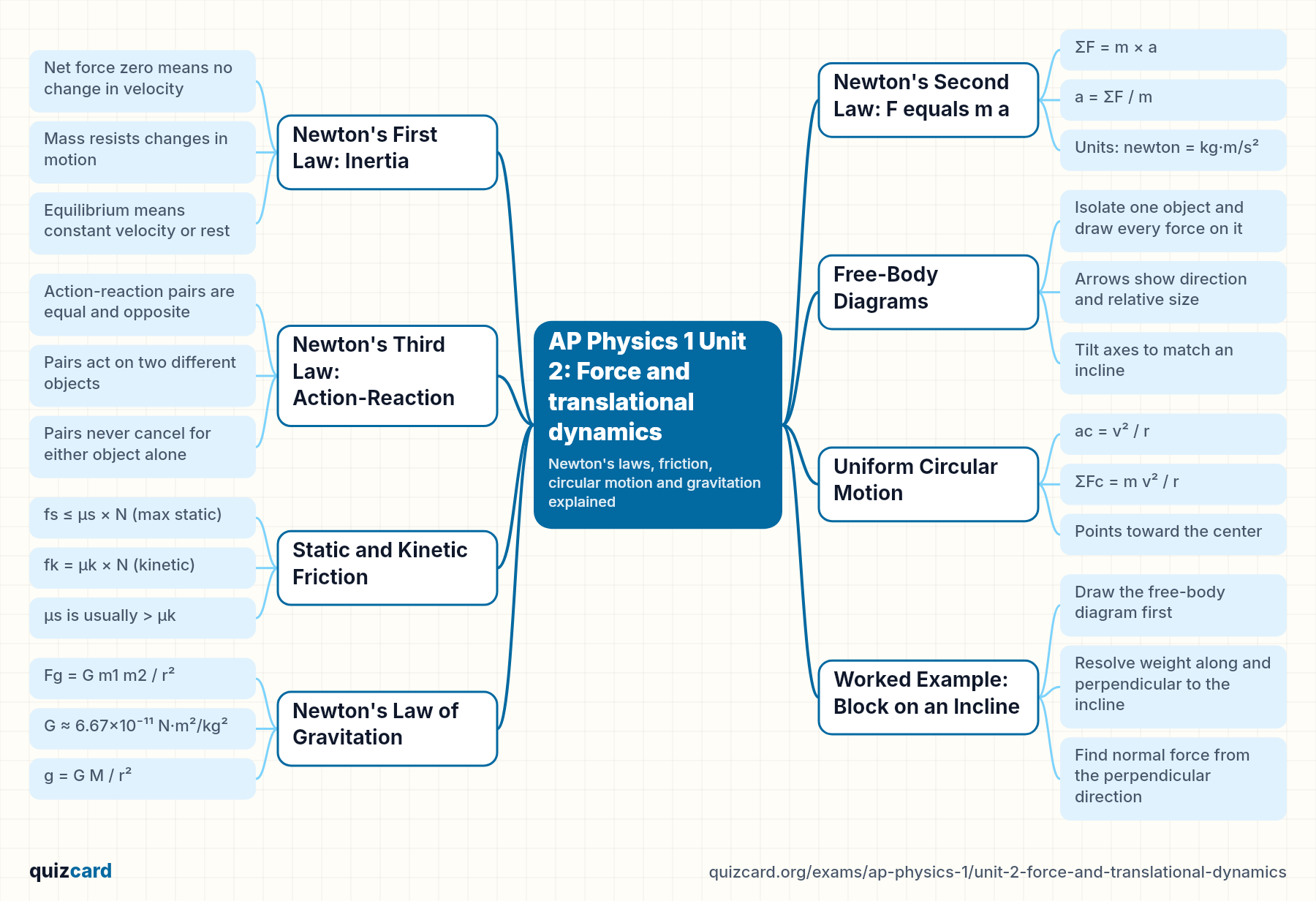
Ever think a moving object needs a constant push to keep going? That's the most common mistake in force and motion, and Newton's laws correct it. This is Unit 2 of AP Physics 1, covering Newton's laws, free-body diagrams, friction, circular motion and gravitation, ending with a worked problem.
Newton's First Law: Inertia
Newton's first law says that an object keeps its velocity constant unless a net external force acts on it. That includes staying at rest, but it also includes moving in a straight line at steady speed. On a frictionless surface, a sliding puck needs no push at all to keep moving. The mistake students often make is assuming motion always requires a force; really, only a change in motion does.
An object at rest stays at rest, and an object in motion stays in motion at constant velocity, unless acted on by a net external force. Newton's First Law
Key points.
- Net force zero means no change in velocity
- Mass resists changes in motion
- Equilibrium means constant velocity or rest
- Motion doesn't require a continuous force
Newton's Second Law: F equals m a
Newton's second law ties force, mass and acceleration together: the net force equals mass times acceleration, so acceleration equals net force divided by mass. The unit of force, the newton, is defined as a kilogram meter per second squared. Say the net force on a two kilogram cart is ten newtons; dividing ten by two gives an acceleration of five meters per second squared, in the direction of that net force.
ΣF = m × a
a = ΣF / m
Units: newton = kg·m/s²
Example: ΣF=10N, m=2kg
a = 10/2 = 5 m/s²
Key points.
- Net force equals mass times acceleration
- Acceleration equals net force divided by mass
- Newton is one kilogram meter per second squared
- Bigger mass needs more force for same acceleration
Newton's Third Law: Action-Reaction
Newton's third law says that when one object pushes on a second, the second pushes back equally hard in the opposite direction, at the same instant. A table pushes up on a book as hard as the book pushes down on the table. These two forces never cancel, since they act on different objects. What matters for one object's acceleration is only the forces acting on that object, not its own reaction pair.
Action-Reaction Pairs
- Equal magnitude, opposite direction
- Act on two different objects
- Same type of force
- Occur at the same instant
Net Force on One Object
- Sum of all forces on that object
- Can include many different force pairs
- Determines that object's acceleration
- Never includes its own reaction force
Free-Body Diagrams
A free-body diagram isolates one object and shows every force acting on it as an arrow, with length suggesting size and direction showing where it points. For a block on a ramp, you'd draw weight pointing straight down, the normal force perpendicular to the ramp's surface, and friction along the surface opposing sliding. Tilting your axes to match the incline makes it easier to apply Newton's second law separately along and perpendicular to the slope.
Key points.
- Isolate one object and draw every force on it
- Arrows show direction and relative size
- Tilt axes to match an incline
- Use the diagram to apply Newton's second law
Static and Kinetic Friction
Friction resists relative sliding between two surfaces. Static friction can take any value up to a maximum equal to the coefficient of static friction times the normal force, adjusting itself to prevent motion. Once an object slides, kinetic friction takes over, equal to the coefficient of kinetic friction times the normal force, usually a bit smaller. That's why it takes more force to start sliding a crate than to keep it sliding.
fs ≤ μs × N (max static)
fk = μk × N (kinetic)
μs is usually > μk
Friction opposes relative sliding
Key points.
- Static friction adjusts up to a maximum value
- Kinetic friction is roughly constant while sliding
- Static coefficient usually exceeds kinetic coefficient
- Friction always opposes relative sliding motion
Uniform Circular Motion
An object moving at constant speed in a circle still accelerates, because its direction keeps changing; that's centripetal acceleration, equal to velocity squared over radius, always pointing toward the center. The net force producing it isn't a new kind of force; it's whatever combination of gravity, tension, friction or normal force points inward. For a car at four meters per second on a two meter radius curve, that acceleration is eight meters per second squared.
ac = v² / r
ΣFc = m v² / r
Points toward the center
v = 4 m/s, r = 2 m
ac = 16/2 = 8 m/s²
Key points.
- Centripetal acceleration points toward the circle's center
- Equals velocity squared divided by radius
- Centripetal force is just the net inward force
- Can come from tension, gravity, friction or normal force
Newton's Law of Gravitation
Newton's law of gravitation says every pair of masses attracts with a force equal to a constant, G, times the product of the masses, divided by the distance between their centers squared. Near Earth's surface, that formula simplifies to the familiar g, about nine point eight meters per second squared, found by plugging Earth's mass and radius into the equation. Move twice as far from Earth's center, and gravitational force drops to one quarter of its original value.
Fg = G m1 m2 / r²
G ≈ 6.67×10⁻¹¹ N·m²/kg²
g = G M / r²
g ≈ 9.8 m/s² at surface
Key points.
- Gravitational force depends on both masses
- Force falls off with distance squared
- Surface gravity comes from Earth's mass and radius
- Doubling distance cuts force to one quarter
Worked Example: Block on an Incline
Picture a five kilogram block sliding down a thirty degree ramp with a kinetic friction coefficient of zero point two. Weight's component along the slope is about twenty four point five newtons, and the component into the surface gives a normal force near forty two point four newtons, making friction about eight point five newtons. Dividing the net force by mass gives an acceleration of roughly three point two meters per second squared down the ramp.
- Draw the free-body diagram: weight, normal, friction
- Resolve weight into components along and perpendicular to the ramp
- Use the perpendicular direction to find the normal force
- Apply Newton's second law along the ramp
- Solve for acceleration using the given numbers
Remember this
The one thing to remember: forces change motion, they don't maintain it, and every problem starts with a clean free-body diagram. Now quiz yourself on this AP Physics 1 material to see what really sticks.
Practice this unit
- MCAT Physics: Fluids, Circuits, Waves and Optics Formulas quiz15 multiple-choice questions with explanations · no account needed
- AP Physics 1: Energy, Momentum and Rotation quiz15 multiple-choice questions with explanations · no account needed
- Physics: Kinematics and Newton's Laws25 flashcards · study free
- Physics: Electricity and Circuits27 flashcards · study free
- MCAT Physics: Fluids, Circuits, Waves and Optics Formulas39 flashcards · study free
- AP Physics 1: Energy, Momentum and Rotation38 flashcards · study free
Every AP Physics 1 deck and quiz: the AP Physics 1 hub.
Other AP Physics 1 unit guides
- Unit 1: KinematicsStudy guide
- Unit 3: Work, energy and powerStudy guide
- Unit 4: Linear momentumGuide + video lesson
- Unit 5: Torque and rotational dynamicsStudy guide
- Unit 6: Energy and momentum of rotating systemsStudy guide
- Unit 7: OscillationsStudy guide
- Unit 8: FluidsStudy guide
Try it with your own material
Upload a PDF, slides or notes and study the deck in minutes. Making your own cards is free with no limits.