Exam prep · AP Physics 1 · Unit guide
AP Physics 1 Unit 5: Torque and rotational dynamics
How forces make things spin, and how to calculate it for AP Physics 1
On the exam: Torque, rotational kinematics and dynamics, rotational inertia. 10 to 15%.
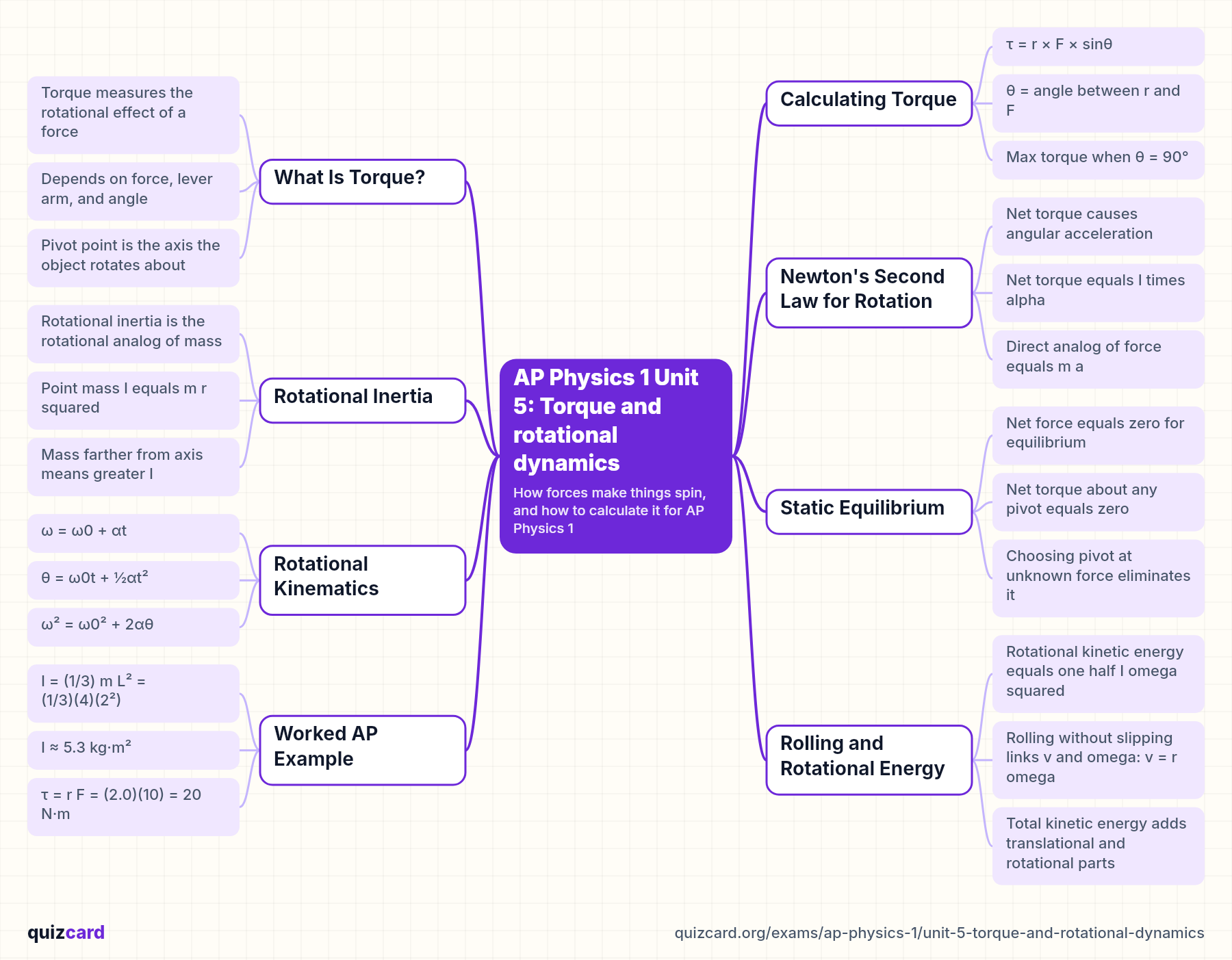
Think torque is just force? That mix-up costs points in AP Physics 1. We'll build torque from scratch, connect it to rotational inertia and angular acceleration, walk through rotational kinematics, and work through a typical exam question together.
What Is Torque?
Push a door near the hinge and it barely moves, but push the same force far from the hinge and it swings open easily. That's torque: the rotational effect of a force around a pivot point, sometimes called the axis of rotation. Torque depends on how much force you apply, how far from the pivot you apply it, that's the lever arm, and the angle between the force and that lever arm.
Key points.
- Torque measures the rotational effect of a force
- Depends on force, lever arm, and angle
- Pivot point is the axis the object rotates about
- Bigger lever arm means more rotational effect
Calculating Torque
The formula for torque magnitude is r times F times the sine of theta, where r is the distance from the pivot to where the force is applied, F is the force, and theta is the angle between them. Torque is maximum when the force is perpendicular to the lever arm, so theta equals ninety degrees. By convention, counterclockwise torques are positive and clockwise torques are negative.
τ = r × F × sinθ
θ = angle between r and F
Max torque when θ = 90°
Counterclockwise = positive
Key points.
- Torque equals r times F times sine theta
- Maximum when force is perpendicular to lever arm
- Counterclockwise torque is positive by convention
- Units are newton meters
Rotational Inertia
Rotational inertia, called I, is the rotational version of mass: it tells you how hard it is to change an object's angular velocity. For a single point mass it's just mass times the distance from the axis squared. But real objects spread their mass out, so a solid disk has less rotational inertia than a hoop of the same mass and radius, because the hoop's mass sits farther from the axis on average.
Point Mass
- I = m r squared
- All mass same distance from axis
- Example: a pendulum bob on a string
Extended Object
- I depends on mass distribution
- Solid disk: one half m r squared
- Hoop: m r squared, mass far from axis
- Rod about center: one twelfth m L squared
Newton's Second Law for Rotation
Just like a net force causes linear acceleration through Newton's second law, a net torque causes angular acceleration. The relationship is net torque equals I times alpha, where alpha is the angular acceleration in radians per second squared, a direct rotational analog of F equals m a. So an object with large rotational inertia, like a merry go round full of people, needs more torque to speed up at the same rate as an empty one.
Key points.
- Net torque causes angular acceleration
- Net torque equals I times alpha
- Direct analog of force equals m a
- Bigger I means harder to spin up
Rotational Kinematics
If angular acceleration is constant, the rotational kinematics equations mirror the linear ones you already know. Angular velocity equals initial angular velocity plus alpha times time. Angular displacement equals initial angular velocity times time plus one half alpha t squared. And angular velocity squared equals initial angular velocity squared plus two alpha theta. Swap position for angle, velocity for angular velocity, and acceleration for angular acceleration, and every trick from linear kinematics still works.
ω = ω0 + αt
θ = ω0t + ½αt²
ω² = ω0² + 2αθ
Key points.
- Angular velocity equals initial plus alpha times time
- Angle equals initial omega t plus half alpha t squared
- Omega squared equals initial omega squared plus two alpha theta
- Same structure as linear kinematics equations
Static Equilibrium
For an object that is not rotating or accelerating, two conditions hold at once: the net force is zero and the net torque about any pivot is zero. A smart trick is to choose your pivot at the point where an unknown force acts, because that force then contributes zero torque and drops out of the equation. This is exactly how you solve problems like a beam held up by two supports, or a sign hanging from a bracket.
- Draw all forces and their points of application
- Choose a pivot, often where an unknown force acts
- Set the sum of all torques equal to zero
- Set the sum of all forces equal to zero
- Solve the resulting equations for the unknowns
Worked AP Example
Here's a typical question. A uniform rod, two meters long and four kilograms, is pivoted at one end, and a ten newton force pushes perpendicular to the rod at the far end. First find the rotational inertia about the pivot: one third m L squared gives one third times four times two squared, about five point three kilogram meters squared. Next the torque is r times F, two times ten, twenty newton meters. Dividing torque by rotational inertia gives an angular acceleration of about three point eight radians per second squared.
I = (1/3) m L² = (1/3)(4)(2²)
I ≈ 5.3 kg·m²
τ = r F = (2.0)(10) = 20 N·m
α = τ / I = 20 / 5.3
α ≈ 3.8 rad/s²
Key points.
- Rod pivoted at end, force applied at far end
- Find I about pivot using one third m L squared
- Find torque as r times F
- Divide torque by I to get angular acceleration
Rolling and Rotational Energy
Spinning objects store kinetic energy too: one half I omega squared, alongside the familiar one half m v squared for translation. When an object rolls without slipping, its center speed and its spin are locked together by v equals r omega. That's why, on a ramp, a solid sphere beats a hollow cylinder to the bottom: the cylinder's mass sits farther from its axis, giving it more rotational inertia, so more of its energy goes into spinning rather than moving forward.
Key points.
- Rotational kinetic energy equals one half I omega squared
- Rolling without slipping links v and omega: v = r omega
- Total kinetic energy adds translational and rotational parts
- Larger I means rolling down a ramp more slowly
Remember this
The one thing to hold onto: torque is force times lever arm times sine of the angle, and it drives angular acceleration the same way force drives linear acceleration in AP Physics 1. Try working a few equilibrium and rotational dynamics problems yourself to see how it sticks.
Practice this unit
- MCAT Physics: Fluids, Circuits, Waves and Optics Formulas quiz15 multiple-choice questions with explanations · no account needed
- AP Physics 1: Energy, Momentum and Rotation quiz15 multiple-choice questions with explanations · no account needed
- Physics: Kinematics and Newton's Laws25 flashcards · study free
- Physics: Electricity and Circuits27 flashcards · study free
- MCAT Physics: Fluids, Circuits, Waves and Optics Formulas39 flashcards · study free
- AP Physics 1: Energy, Momentum and Rotation38 flashcards · study free
Every AP Physics 1 deck and quiz: the AP Physics 1 hub.
Other AP Physics 1 unit guides
- Unit 1: KinematicsStudy guide
- Unit 2: Force and translational dynamicsStudy guide
- Unit 3: Work, energy and powerStudy guide
- Unit 4: Linear momentumGuide + video lesson
- Unit 6: Energy and momentum of rotating systemsStudy guide
- Unit 7: OscillationsStudy guide
- Unit 8: FluidsStudy guide
Try it with your own material
Upload a PDF, slides or notes and study the deck in minutes. Making your own cards is free with no limits.