ACT: Math
From solving equations to right triangles, the core math skills explained clearly
On the exam: Pre-algebra through algebra II, coordinate and plane geometry, and a little trigonometry.
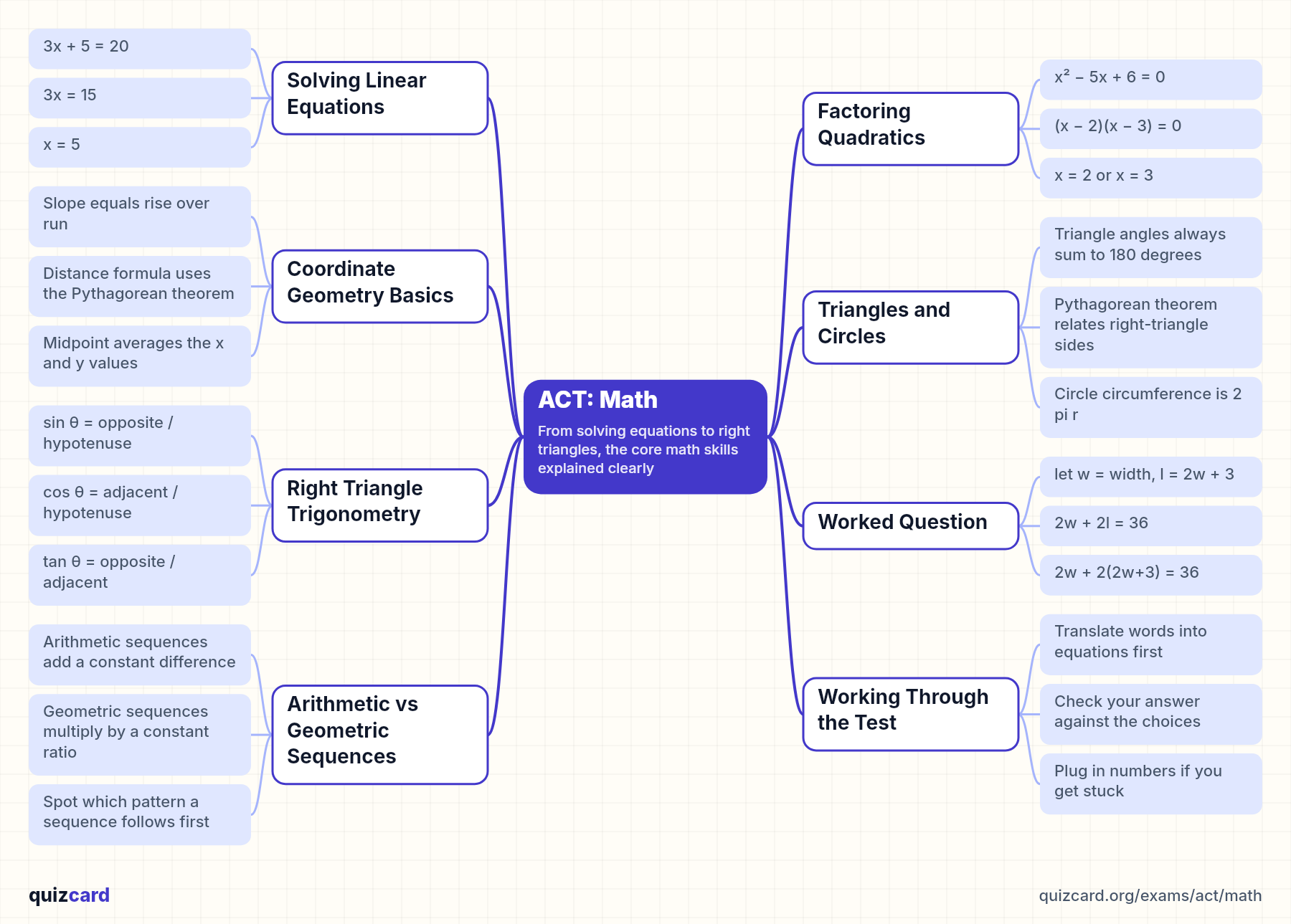
Think you can solve for x in isolation but freeze the moment it's hidden inside a word problem? That's where most students lose points on the ACT math section. In the next few minutes we'll move from basic algebra through coordinate geometry, plane geometry, and trigonometry, then solve a full question together.
Solving Linear Equations
Every algebra problem comes down to isolating a variable. Take three x plus five equals twenty. First you subtract five from both sides, leaving three x equals fifteen. Then you divide both sides by three, and x equals five. The rule is simple: whatever you do to one side of the equation, you must do to the other, keeping it balanced.
3x + 5 = 20
3x = 15
x = 5
Key points.
- Isolate the variable step by step
- Keep both sides of the equation balanced
- Check your answer by substituting back
Factoring Quadratics
Quadratic equations show up constantly, written as x squared minus five x plus six equals zero. You usually want to factor rather than grind through the quadratic formula. Look for two numbers that multiply to six and add to negative five, which are negative two and negative three. That gives you x minus two times x minus three equals zero, so x equals two or x equals three.
x² − 5x + 6 = 0
(x − 2)(x − 3) = 0
x = 2 or x = 3
Key points.
- Set the equation equal to zero
- Find two numbers that multiply and add correctly
- Write it as two binomials
- Solve each factor for x
Coordinate Geometry Basics
On the coordinate plane, slope tells you how steep a line is: rise over run, or the change in y divided by the change in x. Distance between two points comes straight from the Pythagorean theorem, squaring the differences in x and y, adding them, and taking the square root. The midpoint is just the average of the two x values and the average of the two y values.
Key points.
- Slope equals rise over run
- Distance formula uses the Pythagorean theorem
- Midpoint averages the x and y values
- Line equation: y equals m x plus b
Triangles and Circles
Plane geometry leans heavily on two shapes. For triangles, the three interior angles always add up to 180 degrees, and for right triangles the Pythagorean theorem, a squared plus b squared equals c squared, connects the two legs to the hypotenuse. For circles, circumference is two pi r and area is pi r squared, and an arc length is just that fraction of the full circle you're measuring.
Triangles
- Interior angles sum to 180 degrees
- a² + b² = c² for right triangles
- 30-60-90 and 45-45-90 have fixed ratios
Circles
- Circumference equals 2 pi r
- Area equals pi r squared
- Arc length is a fraction of circumference
Right Triangle Trigonometry
Trigonometry questions almost always reduce to SOH CAH TOA. Sine of an angle is opposite over hypotenuse, cosine is adjacent over hypotenuse, and tangent is opposite over adjacent. Picture a right triangle with legs three and four and hypotenuse five: the sine of the angle opposite the side of length three is three fifths, and the cosine of that same angle is four fifths.
sin θ = opposite / hypotenuse
cos θ = adjacent / hypotenuse
tan θ = opposite / adjacent
legs 3, 4, hyp 5 → sin θ = 3/5
Key points.
- SOH: sine is opposite over hypotenuse
- CAH: cosine is adjacent over hypotenuse
- TOA: tangent is opposite over adjacent
Worked Question
Let's work a typical question. A rectangle's length is three more than twice its width, and its perimeter is thirty six. What is the width? Call the width w, so the length is two w plus three. Perimeter equals two w plus two l, which equals thirty six. Substituting gives six w plus six equals thirty six, so w equals five.
let w = width, l = 2w + 3
2w + 2l = 36
2w + 2(2w+3) = 36
6w + 6 = 36
w = 5
Key points.
- Translate the words into variables
- Write the perimeter equation
- Substitute and simplify
- Solve for the unknown
Arithmetic vs Geometric Sequences
Tests like this one check whether you can tell these apart. An arithmetic sequence adds the same number every time, like two, five, eight, eleven, where you keep adding three. A geometric sequence multiplies by the same number every time, like two, six, eighteen, fifty four, where you keep multiplying by three. One grows in a straight line, the other grows exponentially, and mixing them up is a common mistake.
Arithmetic
- Add a constant difference each term
- Grows in a straight line
- Formula: a(n) = a1 + (n−1)d
Geometric
- Multiply by a constant ratio each term
- Grows exponentially
- Formula: a(n) = a1 × r^(n−1)
Working Through the Test
When you sit down with a math question, read it twice so you know exactly what's being asked. Translate the words into an equation or a quick sketch before you touch your calculator. Solve it, then check your answer against the choices given, since a wrong option often matches a common error. If you get stuck, try plugging the answer choices back into the problem instead.
- Read the question twice before solving
- Translate words into an equation or diagram
- Solve, then check against the answer choices
- Plug in numbers when you get stuck
- Keep an eye on your pacing
Remember this
The one thing to remember: translate every word problem into an equation before you reach for a calculator. Review these formulas on your own, then quiz yourself with real ACT practice problems to build the speed this section rewards.
Practice this unit
- Algebra and Geometry: Essential Formulas quiz18 multiple-choice questions with explanations · no account needed
- SAT Vocabulary: 40 High-Frequency Words quiz24 multiple-choice questions with explanations · no account needed
- GRE Quantitative: Arithmetic, Algebra, Geometry and Data Formulas quiz15 multiple-choice questions with explanations · no account needed
- Algebra and Geometry: Essential Formulas30 flashcards · study free
- Geometry: Proofs, Triangles, and Circles30 flashcards · study free
- English Literature: Literary Terms and Devices30 flashcards · study free
- SAT Vocabulary: 40 High-Frequency Words40 flashcards · study free
Every ACT deck and quiz: the ACT hub.
Other ACT unit guides
Try it with your own material
Upload a PDF, slides or notes and study the deck in minutes. Making your own cards is free with no limits.