ACT: English
How to spot grammar and style errors the way the ACT tests them
On the exam: Usage and mechanics (punctuation, grammar, sentence structure) and rhetorical skills (strategy, organization, style).
Think every ACT English question is just about grammar rules you half-remember from middle school? Most of the points actually come from reading in context. This video covers punctuation, sentence structure, and the rhetorical skills of organization and style, then walks through a real question step by step.
The ACT English Test at a Glance
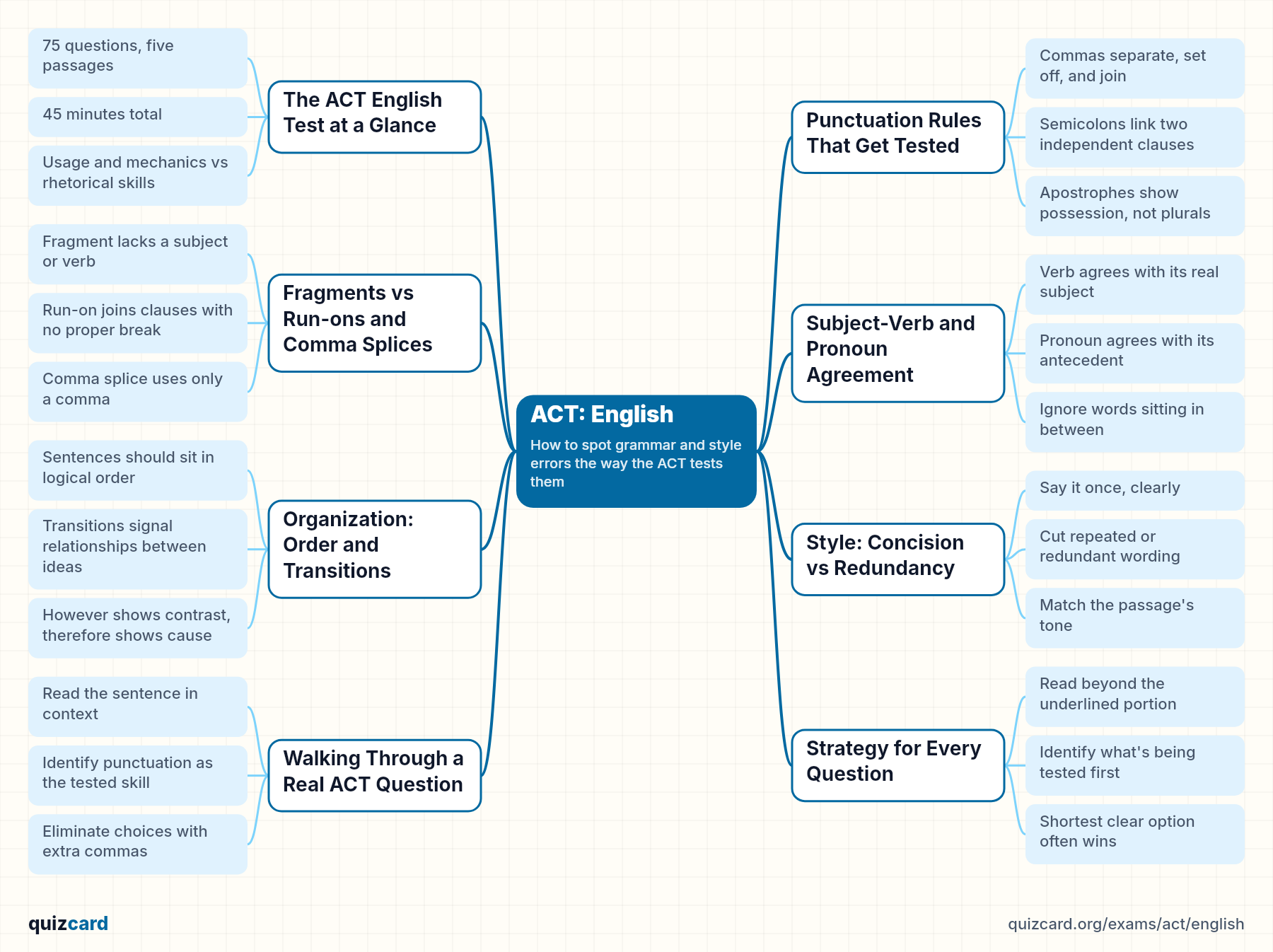
The ACT English test gives you five passages and seventy-five questions, and you get forty-five minutes to finish all of them. Questions fall into two big buckets: usage and mechanics, which covers punctuation, grammar, and sentence structure, and rhetorical skills, which covers strategy, organization, and style. Roughly half the questions come from each bucket, so you need both skill sets solid.
75 Questions across five passages in 45 minutes
Key points.
- 75 questions, five passages
- 45 minutes total
- Usage and mechanics vs rhetorical skills
- Roughly half the questions each
Punctuation Rules That Get Tested
Commas separate items in a list, set off a nonessential clause you could delete, and precede a conjunction joining two complete sentences. A semicolon joins two independent clauses with no conjunction needed. An apostrophe shows possession, as in the dog's leash, never a plain plural. A colon introduces a list or explanation right after a complete sentence.
Key points.
- Commas separate, set off, and join
- Semicolons link two independent clauses
- Apostrophes show possession, not plurals
- Colons introduce lists or explanations
Fragments vs Run-ons and Comma Splices
A fragment is missing a subject, a verb, or a complete thought, so it can't stand alone, like Running to the store. A run-on jams two independent clauses together with no proper break, and a comma splice is the specific case where only a comma tries to do that job, as in I ran, I was late. Fix either one with a period, a semicolon, or a comma plus a word like and or but.
Fragment
- Missing subject or verb
- Can't stand alone
- Example: Running to the store
Run-on / Comma Splice
- Two independent clauses jammed together
- Comma alone can't join them
- Example: I ran, I was late
Subject-Verb and Pronoun Agreement
Here's a rule tested constantly: a verb agrees with its real subject, not with a word sitting closer to it. In 'The list of items was long,' the subject is 'list,' singular, so the verb is 'was,' even though 'items' sits right before it. The same logic applies to pronouns: 'each student' is singular, so it needs 'his or her,' not 'their.'
A verb must agree with its subject in number, and a pronoun must agree with its antecedent in number, no matter what words sit in between. ACT Usage and Mechanics rule
Key points.
- Verb agrees with its real subject
- Pronoun agrees with its antecedent
- Ignore words sitting in between
- Example: the list of items was long
Organization: Order and Transitions
Organization questions ask whether sentences sit in the most logical order and whether a transition word correctly signals the relationship between two ideas, like however for contrast or therefore for cause and effect. You'll also be asked whether to add, delete, or move a sentence based on whether it actually serves the paragraph's or the essay's main purpose, not just whether it sounds nice.
Key points.
- Sentences should sit in logical order
- Transitions signal relationships between ideas
- However shows contrast, therefore shows cause
- Add or cut sentences based on purpose
Style: Concision vs Redundancy
Style questions reward the version that says something once, clearly, in the fewest words that still carry the meaning. 'He was totally unaware and had no clue' repeats the same idea twice, so the ACT wants you to cut it down to 'he was unaware.' Style also means matching the tone of the passage, so a casual essay shouldn't suddenly drop in stiff, formal phrasing, or the reverse.
Concise and Clear
- States the idea once
- Uses only necessary words
Wordy and Redundant
- Repeats the same idea twice
- Adds words that add nothing
Walking Through a Real ACT Question
Take this underlined sentence: 'The ancient, city of Petra, was carved into rock.' First you read the surrounding sentences for context. Then you name the skill being tested, which here is punctuation. The commas split the subject from its verb for no reason, so you eliminate any choice that keeps a comma there. The correct answer removes both: 'The ancient city of Petra was carved into rock.'
- Read the sentence plus the context around it
- Name what's being tested: here, punctuation
- Spot the error: commas split subject from verb
- Eliminate choices that keep or add errors
- Choose: The ancient city of Petra was carved into rock
Strategy for Every Question
A few habits save points. Always read beyond the underlined part, since the right answer often depends on a sentence before or after it. Figure out exactly what's being tested before you look at the choices. When meaning stays the same, the shortest, clearest option usually wins. And don't assume NO CHANGE is a trap; it's correct on a good share of questions, so test it like any other choice.
Key points.
- Read beyond the underlined portion
- Identify what's being tested first
- Shortest clear option often wins
- NO CHANGE is correct fairly often
Remember this
The one thing to remember: always read beyond the underlined words, because context decides the right answer on the ACT English test. Now quiz yourself on fragments, agreement, and transitions until the fixes feel automatic.
Practice this unit
- Algebra and Geometry: Essential Formulas quiz18 multiple-choice questions with explanations · no account needed
- SAT Vocabulary: 40 High-Frequency Words quiz24 multiple-choice questions with explanations · no account needed
- GRE Quantitative: Arithmetic, Algebra, Geometry and Data Formulas quiz15 multiple-choice questions with explanations · no account needed
- Algebra and Geometry: Essential Formulas30 flashcards · study free
- Geometry: Proofs, Triangles, and Circles30 flashcards · study free
- English Literature: Literary Terms and Devices30 flashcards · study free
- SAT Vocabulary: 40 High-Frequency Words40 flashcards · study free
Every ACT deck and quiz: the ACT hub.
Other ACT unit guides
Try it with your own material
Upload a PDF, slides or notes and study the deck in minutes. Making your own cards is free with no limits.