SAT: Reading and Writing: Standard English Conventions
Learn the punctuation, sentence-boundary, and agreement rules behind about a quarter of SAT questions
On the exam: Punctuation, sentence boundaries, agreement. About 26%.
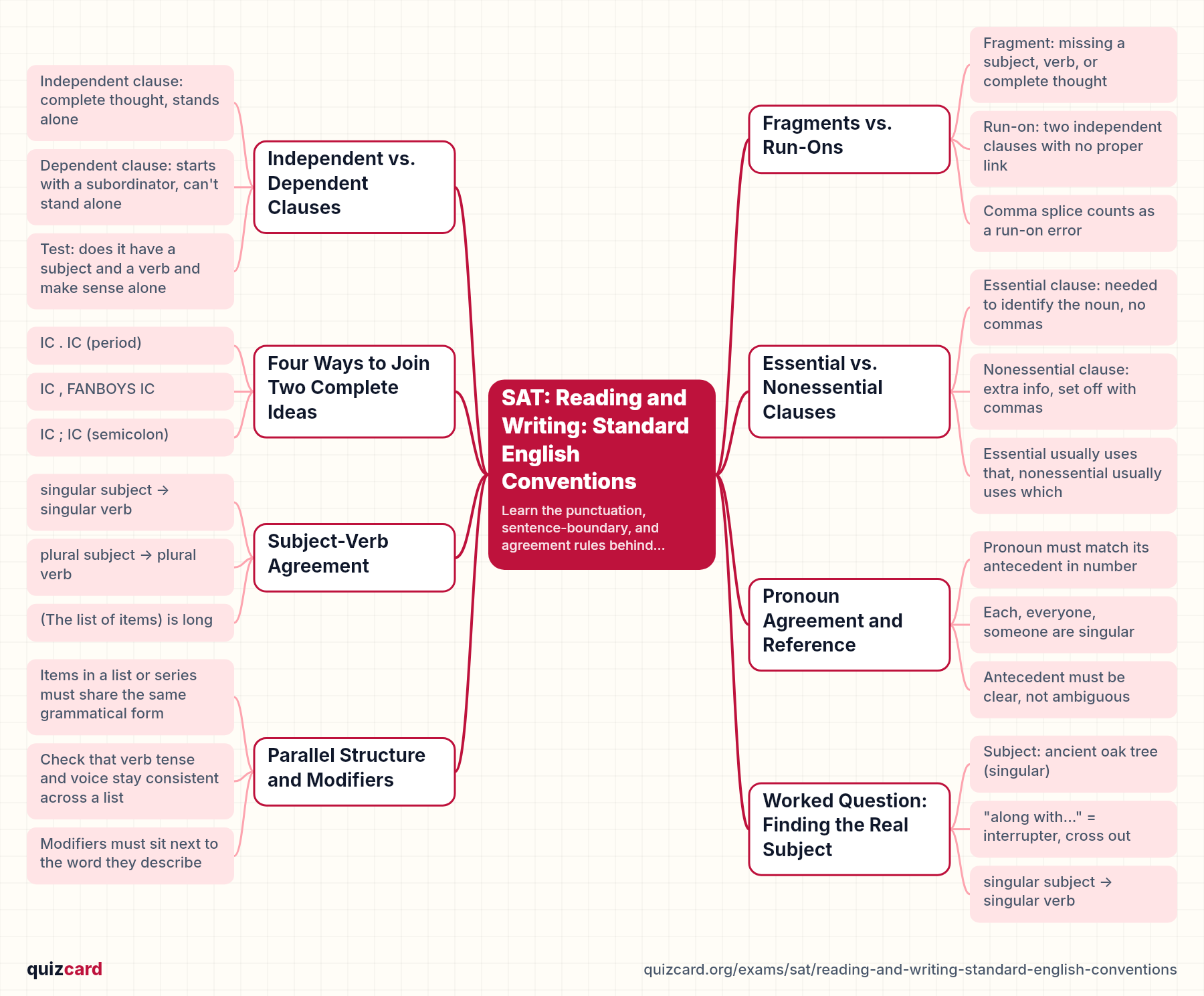
Can you tell a comma splice from a correctly joined sentence on sight? Most students can't, and on the SAT that gap shows up again and again, since Standard English Conventions make up roughly a quarter of the Reading and Writing section. Here's how clauses, punctuation, and agreement actually work.
Independent vs. Dependent Clauses
Every sentence rule on the test comes back to one idea: can a group of words stand alone. An independent clause has a subject and a verb and makes complete sense by itself, like 'we went outside.' A dependent clause, like 'although it was raining,' starts with a word such as although, because, or when, and leaves you hanging. Spotting which is which is the first skill everything else builds on.
Key points.
- Independent clause: complete thought, stands alone
- Dependent clause: starts with a subordinator, can't stand alone
- Test: does it have a subject and a verb and make sense alone
- Words like although, because, when start dependent clauses
Fragments vs. Run-Ons
The two classic boundary errors are opposites of each other. A fragment is a piece of a sentence standing alone, like 'because she left,' which never finishes its thought. A run-on happens when two complete sentences get mashed together without the right punctuation, like 'she left, he stayed,' which is called a comma splice because a comma alone can't join two independent clauses. The fix for both is always punctuation or structure, never guessing.
Fragment
- Because she left.
- No complete thought
- Often missing subject or verb
Run-On
- She left, he stayed.
- Two full sentences, no link
- Comma alone can't join them
Four Ways to Join Two Complete Ideas
When you have two independent clauses, there are really only four legal ways to connect them. You can split them with a period. You can use a comma plus one of the FANBOYS words, like and, but, or so. You can use a semicolon on its own, with no conjunction needed. Or you can use a colon, but only when the second clause explains or expands on the first one, like 'she had one goal: graduate.'
IC . IC  (period)
IC , FANBOYS IC
IC ; IC  (semicolon)
IC : IC  (second explains first)
Key points.
- Period separates them into two sentences
- Comma plus FANBOYS word joins them
- Semicolon joins them without a conjunction
- Colon joins them when the second explains the first
Essential vs. Nonessential Clauses
Commas around a describing clause depend on whether the information is necessary. An essential clause identifies exactly which thing you mean, so it gets no commas, as in 'the book that I borrowed is overdue.' A nonessential clause just adds extra detail about something already identified, so it gets commas, as in 'my car, which is red, is parked outside.' Notice that essential clauses tend to use that, nonessential ones tend to use which.
Essential, no commas
- Identifies which noun
- Usually uses "that"
- The book that I borrowed...
Nonessential, commas
- Adds extra detail
- Usually uses "which"
- My car, which is red, ...
Subject-Verb Agreement
Agreement questions test whether you can find the true subject of a verb, even when the test tries to hide it. The rule is simple: singular subject, singular verb; plural subject, plural verb. The trick is interrupters. In 'the list of items is long,' the subject is list, not items, so the verb stays singular even though items sits right before it. Always cross out the phrase in between and check what's left.
singular subject → singular verb
plural subject → plural verb
(The list of items) is long
cross out interrupter, check subject
Key points.
- Singular subject takes a singular verb
- Plural subject takes a plural verb
- Ignore interrupting phrases between subject and verb
- Compound subjects joined by and are usually plural
Pronoun Agreement and Reference
A pronoun has to agree with the noun it replaces, called its antecedent, in number. Words like each, everyone, and someone are singular, so they pair with singular pronouns even though they sound like they mean a group. The other common issue is clarity: if a sentence has two possible nouns a pronoun could refer to, like 'Maria told Sarah that she was late,' the reference is ambiguous and the test will flag it as an error.
Key points.
- Pronoun must match its antecedent in number
- Each, everyone, someone are singular
- Antecedent must be clear, not ambiguous
- Unclear "it" or "they" with two possible nouns is an error
Parallel Structure and Modifiers
Parallel structure means every item in a list or comparison has to use the same grammatical form, so 'she likes hiking, swimming, and biking' is correct, but swapping the last one to 'to bike' breaks the pattern. Modifier placement works differently: the describing phrase has to sit next to what it actually describes. 'Walking to school, the rain started' is wrong, because the rain can't walk, so the sentence needs a person doing the walking right after that phrase.
- List items in a series, keep the same grammatical form
- Match verb tense and voice across the list
- Place modifying phrases next to what they describe
- Add a logical subject if a modifier would dangle
Worked Question: Finding the Real Subject
Here's a typical question: 'The ancient oak tree, along with the smaller shrubs surrounding it, blank in need of pruning,' and you pick between is, are, were, or being. First, find the subject: it's 'ancient oak tree,' singular. Second, cross out 'along with the smaller shrubs surrounding it,' because that's an interrupting phrase, not part of the subject. With the interrupter gone, a singular subject needs a singular verb, so the answer is 'is.'
Subject: ancient oak tree (singular)
"along with..." = interrupter, cross out
singular subject → singular verb
Answer: (B) is
Key points.
- Underlined verb has to agree with the true subject
- Cross out the interrupting phrase first
- Find the noun that actually controls the verb
- Pick the verb that matches that noun's number
Remember this
The one thing to remember: every one of these questions comes down to finding the true subject or clause and matching it correctly, interrupters and all. On the SAT, that habit is worth more than memorizing rules. Try quizzing yourself on a few practice sentences before you move on.
Practice this unit
- SAT Vocabulary: 40 High-Frequency Words quiz24 multiple-choice questions with explanations · no account needed
- Algebra and Geometry: Essential Formulas quiz18 multiple-choice questions with explanations · no account needed
- GRE Quantitative: Arithmetic, Algebra, Geometry and Data Formulas quiz15 multiple-choice questions with explanations · no account needed
- SAT Vocabulary: 40 High-Frequency Words40 flashcards · study free
- Algebra and Geometry: Essential Formulas30 flashcards · study free
- Geometry: Proofs, Triangles, and Circles30 flashcards · study free
- English Literature: Literary Terms and Devices30 flashcards · study free
Every SAT deck and quiz: the SAT hub.
Other SAT unit guides
- Math: Advanced MathStudy guide
- Math: AlgebraStudy guide
- Math: Geometry and TrigonometryStudy guide
- Math: Problem-Solving and Data AnalysisStudy guide
- Reading and Writing: Craft and StructureStudy guide
- Reading and Writing: Expression of IdeasStudy guide
- Reading and Writing: Information and IdeasStudy guide
Try it with your own material
Upload a PDF, slides or notes and study the deck in minutes. Making your own cards is free with no limits.