SAT: Math: Algebra
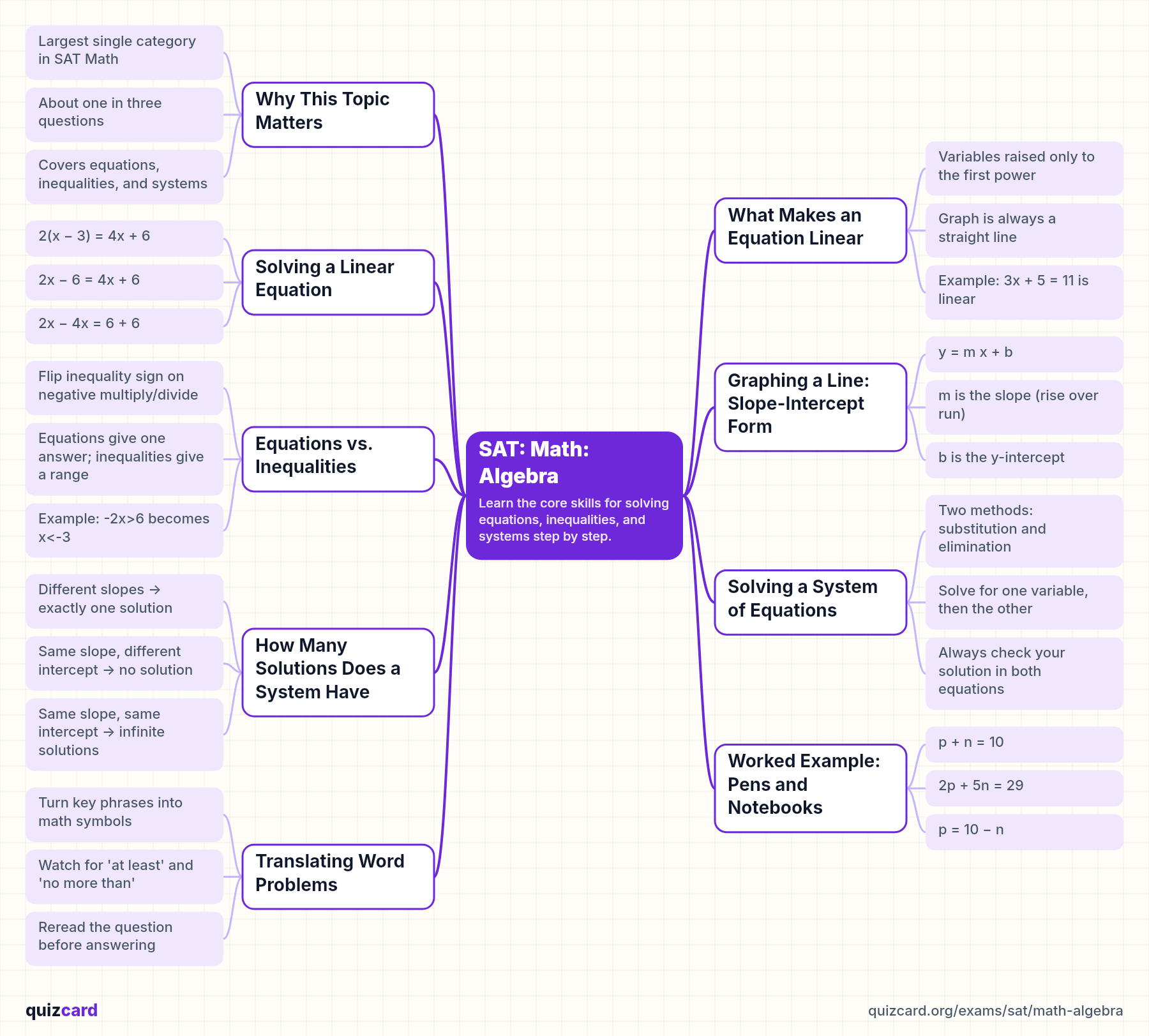
Learn the core skills for solving equations, inequalities, and systems step by step.
On the exam: Linear equations, inequalities and systems. About 35% of the section.
Ever flip an inequality sign at the wrong moment and watch a right answer turn wrong? On the SAT, linear equations, inequalities, and systems make up roughly a third of the math section. This video covers how they work, from solving for x to turning word problems into two equations.
Why This Topic Matters
Linear equations, inequalities, and systems aren't a small corner of the SAT. They make up about thirty five percent of the math section, more than any other topic. That means roughly one in three math questions will ask you to solve for a variable, graph a line, or untangle two equations at once. Getting comfortable with these basics pays off across the whole test.
35% share of SAT Math questions covering linear equations, inequalities, and systems
Key points.
- Largest single category in SAT Math
- About one in three questions
- Covers equations, inequalities, and systems
- Knowing the basics pays off broadly
What Makes an Equation Linear
Here's the definition that matters: a linear equation is one where every variable shows up only to the first power, never squared or under a root. That's why its graph is always a straight line. For example, three x plus five equals eleven is linear, but x squared plus five equals eleven is not. The SAT tests this distinction constantly, so recognizing it instantly saves time.
A linear equation is one where every variable appears only to the first power, so its graph is a straight line. Algebra fundamentals
Key points.
- Variables raised only to the first power
- Graph is always a straight line
- Example: 3x + 5 = 11 is linear
- x² + 5 = 11 is not linear
Solving a Linear Equation
Let's solve two times the quantity x minus three equals four x plus six. Distributing gives two x minus six equals four x plus six. Moving the x terms to one side and the numbers to the other gives negative two x equals twelve. Dividing both sides by negative two gives x equals negative six.
2(x − 3) = 4x + 6
2x − 6 = 4x + 6
2x − 4x = 6 + 6
−2x = 12
x = −6
Key points.
- Distribute first: 2(x−3) → 2x−6
- Group x terms on one side
- Combine constants on the other
- Divide to isolate x
Graphing a Line: Slope-Intercept Form
Every line can be written as y equals m x plus b, where m is the slope and b is the y-intercept, the point where the line crosses the vertical axis. If y equals two x plus three, the line crosses at three and climbs two units for every one unit it moves right. The SAT often gives this form directly, or asks you to build it from two points.
Key points.
- y = m x + b
- m is the slope (rise over run)
- b is the y-intercept
- Bigger m means a steeper line
Equations vs. Inequalities
Inequalities work almost like equations, with one key twist: multiplying or dividing both sides by a negative number flips the inequality sign. For example, negative two x is greater than six becomes x is less than negative three once you divide by negative two and flip the sign. Forgetting that flip is one of the most common mistakes students make.
Equations
- Uses an equals sign
- Usually one exact solution
- Graphs as a single line
Inequalities
- Uses <, >, ≤, or ≥
- Solution is a range of values
- Flip the sign on negative multiply/divide
- Graphs as a shaded region or ray
Solving a System of Equations
To solve a system like two x plus y equals ten and x minus y equals two, you can substitute or eliminate. Solving the second equation gives x equals y plus two; plugging that into the first gives y equals two, so x equals four. Always check both numbers in both original equations before moving on.
- Write both equations clearly
- Pick substitution or elimination
- Solve for one variable first
- Substitute back to find the other
- Check both answers in both equations
How Many Solutions Does a System Have
Not every system gives one tidy answer. Different slopes mean the lines cross once, so there's one solution. Same slope but different y-intercepts means the lines are parallel and never meet, so there's no solution. Same slope and same intercept means the equations describe the same line, giving infinitely many solutions, like two x plus three y equals six and four x plus six y equals twelve.
Key points.
- Different slopes → exactly one solution
- Same slope, different intercept → no solution
- Same slope, same intercept → infinite solutions
Worked Example: Pens and Notebooks
Here's a typical SAT question. Pens cost two dollars, notebooks cost five, and Alex buys ten items for twenty nine dollars. We set up two equations: p plus n equals ten, and two p plus five n equals twenty nine. Solving the first for p gives ten minus n. Substituting gives twenty plus three n equals twenty nine, so n equals three and p equals seven.
p + n = 10
2p + 5n = 29
p = 10 − n
2(10 − n) + 5n = 29
20 + 3n = 29
n = 3, p = 7
Key points.
- Translate the word problem into two equations
- Solve one equation for a variable
- Substitute into the second equation
- Solve for the remaining unknown
Translating Word Problems
The hardest part is often turning words into math, not solving the equation itself. Phrases like 'at least' mean greater than or equal to, while 'no more than' means less than or equal to. Always reread the question, because the SAT often asks for a different quantity than the one you solved for. Checking that your answer makes sense catches most careless errors.
Key points.
- Turn key phrases into math symbols
- Watch for 'at least' and 'no more than'
- Reread the question before answering
- Check that your answer makes sense
Remember this
The one thing to remember: on the SAT, flip the inequality sign when multiplying or dividing by a negative, and always check what the question actually asks for. Try quizzing yourself on a few practice problems next.
Practice this unit
- SAT Vocabulary: 40 High-Frequency Words quiz24 multiple-choice questions with explanations · no account needed
- Algebra and Geometry: Essential Formulas quiz18 multiple-choice questions with explanations · no account needed
- GRE Quantitative: Arithmetic, Algebra, Geometry and Data Formulas quiz15 multiple-choice questions with explanations · no account needed
- SAT Vocabulary: 40 High-Frequency Words40 flashcards · study free
- Algebra and Geometry: Essential Formulas30 flashcards · study free
- Geometry: Proofs, Triangles, and Circles30 flashcards · study free
- English Literature: Literary Terms and Devices30 flashcards · study free
Every SAT deck and quiz: the SAT hub.
Other SAT unit guides
- Math: Advanced MathStudy guide
- Math: Geometry and TrigonometryStudy guide
- Math: Problem-Solving and Data AnalysisStudy guide
- Reading and Writing: Craft and StructureStudy guide
- Reading and Writing: Expression of IdeasStudy guide
- Reading and Writing: Information and IdeasStudy guide
- Reading and Writing: Standard English ConventionsStudy guide
Try it with your own material
Upload a PDF, slides or notes and study the deck in minutes. Making your own cards is free with no limits.